
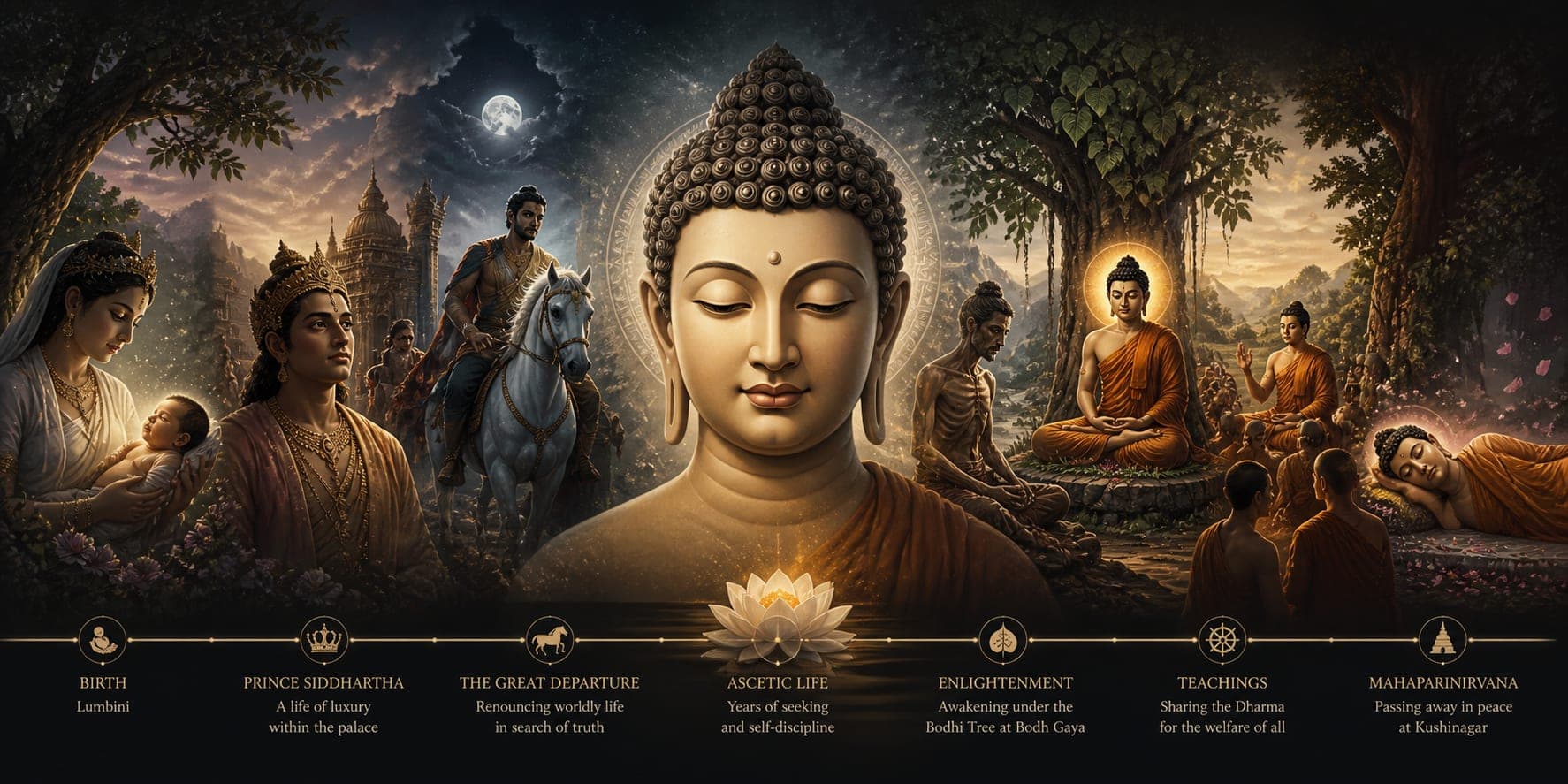
Gautam Buddha
The Supreme Buddha who transformed human consciousness itself, born in Lumbini, Nepal, who renounced princely luxury to discover the path to universal liberation. His teachings on suffering, enlightenment, and the Middle Way spawned the world's largest religions and fundamentally altered the spiritual trajectory of billions across Asia and beyond.
Profile Narrative
Episode 1: The Birth of a Prince in Lumbini's Sacred Gardens
On the full moon day of May in 563 BCE, in the lush gardens of Lumbini—located in the Terai plains of what is now southern Nepal—history witnessed the birth of a child who would later transform human consciousness. Prince Siddhartha Gautama was born to King Suddhodana of the Shakya clan and Queen Mahamaya (also known as Maya Devi). The Shakyas were a warrior caste, and their kingdom of Kapilvastu stretched across the fertile valleys of ancient Nepal and the border regions of what is now northern India.
The circumstances of his birth were extraordinary. According to ancient Buddhist texts, Queen Maya Devi was traveling in her palanquin (a carried royal seat) toward her parents' home in the neighboring kingdom of Devdaha when labor unexpectedly began. The queen stopped at the Lumbini grove, where she clasped the branch of a sal tree and gave birth to the prince while standing—a miraculous and sacred event that would be immortalized in stone sculptures that survive to this day.
Yet tragedy struck within seven days. Queen Maya Devi, exhausted from childbirth, succumbed to a fever and passed into the realm beyond. The newborn Siddhartha was then lovingly raised by his aunt, Prajapati Gautami, who became his second mother. King Suddhodana was devastated, but he held profound expectations for his son. According to Shakya tradition, a sage named Asita had visited the royal palace and prophesied that the child would either become a great universal monarch—a 'Chakravartin' king—or, if he encountered the realities of human suffering, he would renounce his kingdom entirely and become an enlightened sage or 'Buddha.'
This prophecy would haunt King Suddhodana for the rest of his life. Determined to ensure his son's worldly success and prevent his renunciation, the king made a fateful decision: he would shield young Siddhartha from all knowledge of human suffering, sickness, old age, and death. He constructed three palatial compounds—summer, autumn, and winter palaces—each surrounded by impenetrable walls, where Siddhartha would be enclosed in a cocoon of unrelenting luxury, pleasure, and comfort.
Episode 2: The Sheltered Prince and the Veiled Kingdom
Siddhartha's childhood was unlike any human child's experience. He grew up enveloped in an almost dreamlike existence of extraordinary affluence. Servants dressed him in the finest silks imported from distant kingdoms. His meals featured the most exotic delicacies prepared by master chefs. Musicians, dancers, and courtly entertainers performed constantly within the palace walls. Beautiful courtesans were brought to pleasure him, and he was shielded from any sight of poverty, sorrow, or the harsh realities of existence.
Yet, amidst this artificial paradise, Siddhartha developed into a young man of exceptional intelligence, grace, and contemplative depth. He mastered all the martial arts—archery, swordsmanship, wrestling—becoming a formidable warrior of his age. He was also trained in mathematics, astronomy, philosophy, and the Vedic scriptures of the Hindu tradition. His father ensured he was educated by the finest scholars.
At the age of sixteen, King Suddhodana arranged his marriage to a neighboring princess named Yasodhara, a woman of extraordinary beauty and gentleness. The two were deeply devoted to each other, and within a few years, Yasodhara gave birth to a son, Rahula, whose name means 'chain' or 'fetter'—symbolizing, perhaps, the bonds that tie one to worldly existence.
Yet despite his palatial surroundings, growing material success, and family happiness, a profound restlessness began to stir in Siddhartha's heart. The artificial boundary between himself and the world could not hold forever. Servants whispered rumors of suffering beyond the palace walls. He began to pose philosophical questions to his tutors that went far deeper than mere intellectual exercise. He questioned the nature of existence, the inevitability of death, and the purpose of human life. His father, sensing the awakening within his son, grew increasingly anxious.
Episode 3: The Four Sights That Shattered Paradise
The turning point came when Siddhartha, now a young man of approximately twenty-nine years of age, insisted on leaving the palace to visit the city of Kapilvastu. His father, terrified of his son witnessing suffering, ordered the city streets to be cleared of all elderly people, sick individuals, corpses, and ascetics. Every possible image of human pain was removed.
Yet fate—or perhaps karmic inevitability—had other designs.
On his first excursion, Siddhartha encountered an elderly man, bent with age, his skin wrinkled, his teeth fallen. Shocked, Siddhartha asked his charioteer, Channa, what he was witnessing. 'This is old age,' Channa replied with deep sadness, explaining that all humans eventually decay and deteriorate. The prince returned to the palace, his mind aflame with questions.
On his second journey out, Siddhartha witnessed a man wracked with disease—his body covered in sores, his breathing labored, his face distorted with pain. Again, Channa explained: 'This is sickness. It strikes without warning.' Siddhartha wept, recognizing that neither wealth nor royal status could protect one from illness.
On the third occasion, Siddhartha encountered a funeral procession—a corpse being carried toward the cremation grounds, its body rigid and lifeless. 'This is death,' Channa whispered. 'It comes for everyone—kings, beggars, the wise and the foolish alike. No amount of pleasure, possessions, or power can prevent it.' Siddhartha sat in profound silence for hours, contemplating the finality of mortality.
On the fourth and final vision, Siddhartha encountered a wandering ascetic—a simple man with shaved head and orange robes, his face peaceful and serene despite his evident poverty. The man carried only a walking staff and a begging bowl, yet there radiated from him a profound spiritual calm and inner freedom. 'Who is this man?' asked Siddhartha. 'This is an ascetic, a spiritual seeker who has renounced the world in pursuit of truth and liberation,' replied Channa.
These Four Sights—old age, sickness, death, and the ascetic—catalyzed a spiritual earthquake within Siddhartha's consciousness. In that moment, the artificial paradise constructed by his father collapsed utterly. All the silks, treasures, songs, and caresses became meaningless in the face of inevitable suffering. He realized that his palatial existence was built upon an illusion—that he had been living in a carefully constructed denial of reality itself.
Episode 4: The Great Renunciation - The Prince Becomes a Seeker
That very night, in approximately 534 BCE, when Siddhartha was twenty-nine years old, a profound resolve crystallized in his heart. He made a decision that would alter the course of human history: he would leave everything behind and seek the truth about suffering and liberation.
It was a night of extraordinary internal turmoil and clarity. Siddhartha moved through the palace one final time, walking past his sleeping wife, Yasodhara, and his infant son, Rahula. He gazed at them with an almost unbearable tenderness, knowing that he would likely never see them again. Yet he also understood, with the certainty of one touched by transcendent truth, that his departure was not a abandonment of love, but rather an act of ultimate compassion—for if he could discover the nature of suffering and its cessation, he could eventually help all beings, including his beloved family.
He then walked to the stables, where his faithful horse, Kanthaka, waited. His loyal companion, the charioteer Channa, was there. With a single decisive gesture, Siddhartha drew his sword and cut away his long hair, the traditional symbol of a Shakya prince, casting it into the sky as an offering to the heavens. He removed his silken robes and replaced them with the simple orange garment of a wandering ascetic. He gave his horse, his jewelry, and his royal insignia to Channa with instructions to return them to King Suddhodana, along with a message: 'Father, I have not abandoned you out of disrespect, but out of respect for truth.'
With nothing but the clothes on his back and an unquenchable thirst for enlightenment, Prince Siddhartha Gautama walked into the forest and became Siddhartha the Seeker.
Episode 5: The Years of Extreme Asceticism and the Dangerous Illusion
For six long years, from approximately 534 to 528 BCE, Siddhartha subjected himself to practices of extraordinary self-mortification in pursuit of enlightenment. He believed—as was taught by many ascetic traditions of his time—that by denying the body and transcending physical sensation, he could achieve spiritual breakthrough.
He lived in forest caves and riverbank dwellings, wearing only torn rags and a loincloth. He fasted for extended periods, consuming sometimes only a single grain of rice or a drop of sesame oil per day. His body became skeletal—his ribs protruded like the beams of an abandoned house. He slept on beds of thorns and sharp stones. He subjected himself to extremes of temperature, meditating naked in winter frost and under the scorching summer sun. He practiced intense breathwork and pranayama (yogic breathing) so forcefully that he would vomit blood.
Other ascetics heard of his extreme practices and gathered around him, forming a small monastic community of five disciples who followed his example with admiration. Yet despite these extraordinary mortifications—despite the pain, the hunger, the physical deterioration—enlightenment continued to elude him. His mind remained clouded by suffering, his body weakened beyond functional capability.
One day, while walking to a river, Siddhartha collapsed from severe malnutrition and came close to death. As he recovered, he experienced a crucial moment of realization: the path of extreme self-denial was not leading toward liberation but rather toward the destruction of his body and the darkening of his mind. He recognized that the very asceticism intended to liberate him was creating a new form of bondage—the bondage of self-torture.
Moreover, he remembered a moment from his childhood: once, while his father was attending to state matters, young Siddhartha sat beneath a rose-apple tree. In that moment, freed from the distractions of the palace, his mind became naturally concentrated, calm, and radiant. He had experienced a profound inner peace not through self-denial, but through a balanced, moderate approach.
This recollection sparked a revolutionary insight: neither extreme indulgence (as he had practiced in the palace) nor extreme asceticism (as he had practiced in the forest) led to enlightenment. The path to liberation lay in a Middle Way—a balanced approach that neither clung to pleasure nor rejected the body's basic needs.
Episode 6: The Bodhi Tree and the 49 Days of Awakening
With this profound understanding, Siddhartha changed his approach. He bathed in the river, washing away the filth of six years of extreme asceticism. A local woman named Sujata offered him a bowl of nourishing rice porridge with milk. He ate gratefully, feeling strength gradually return to his body. His five disciples, shocked by this apparent 'compromise,' abandoned him, believing he had returned to worldly indulgence and abandoned the spiritual path.
Yet Siddhartha was undeterred. Around 528 BCE, at approximately thirty-five years of age, he journeyed to the town of Bodh Gaya in what is now Bihar, India. There, beneath a sprawling Bodhi tree (a species of fig tree, Ficus religiosa), on the banks of the River Neranjara, he made a solemn vow: he would not leave this spot until he achieved complete enlightenment or died in the attempt.
He sat in the lotus position, his spine erect, his hands folded in his lap, facing east. And then he began to meditate with an intensity of focus that had no parallel in human history.
Buddhist tradition recounts that throughout the night of his meditation, supernatural forces—led by Mara, the personification of delusion, temptation, and the forces opposing enlightenment—arose to obstruct him. Mara attacked with terrible storms, thunder, and lightning. He sent violent visions designed to terrify: armies of demons, floods, walls of fire. He assaulted Siddhartha with temptations of the senses—sending beautiful celestial women to distract him, each representing a different form of desire and attachment.
Yet Siddhartha remained immovable. He recognized all these visions as projections of his own mind—neither fully real nor ultimately substantial. He watched the demonic forces approach, and rather than resisting them, he observed them with equanimous awareness, understanding their illusory nature. Each time a demon appeared, it dissolved like mist before the sun of his consciousness.
According to the texts, Mara, in desperation, challenged Siddhartha's right to achieve enlightenment. 'Who is your witness?' Mara demanded. 'Who can attest to your worthiness?'
In response, Siddhartha extended his right hand and touched the earth beneath him, calling the Earth herself (Prithvi Devi) to witness his worthiness. The Earth responded with a deafening roar, a cosmic acknowledgment that reverberated through all the heavens and underworlds. In that moment, Mara and all his forces were vanquished.
As dawn broke on the 49th day of meditation (having meditated for seven weeks), Siddhartha's eyes opened. In a single flash of transcendent insight, he perceived simultaneously: the full nature of suffering and its causes, the path leading to its cessation, and the final attainment of Nirvana—complete liberation from the cycle of birth and death. In that moment, Prince Siddhartha Gautama became Shakyamuni Buddha—'the Awakened One,' 'the Sage of the Shakyas.'
He had achieved complete enlightenment at the age of thirty-five.
Episode 7: The First Sermon and the Turning of the Wheel of Dharma
For seven weeks after his enlightenment, Buddha remained in deep meditation beneath the Bodhi tree, integrating his profound realization. When he emerged, he faced a critical choice: he could enter Parinirvana (complete final liberation) immediately, or he could remain in the world and share his teachings with suffering beings.
The accounts tell that the god Brahma and other celestial deities descended to petition Buddha: 'Please, O Enlightened One, teach the Dharma (the cosmic law and truth) to suffering beings. There are some with only little dust in their eyes who will grasp your teachings and attain liberation.'
Moved by compassion for all beings, Buddha agreed. Around 527 BCE, he traveled to the city of Sarnath, to the Deer Park where ascetics gathered. His five former disciples—the ones who had abandoned him when he changed his ascetic practices—were meditating there. Initially, they resolved to ignore him, but as he drew near, something in his radiant presence prevented them from maintaining their distance.
Buddha sat beneath a tree and delivered what would become known as the First Sermon or the Sermon of the Four Noble Truths. This discourse became the foundation of all Buddhist teaching:
The First Noble Truth: Dukkha (Suffering) Buddha taught that life inevitably involves suffering (dukkha). This includes not merely pain and sorrow, but also the dissatisfaction inherent in all conditioned experiences—the unsatisfactoriness that comes from impermanence, from the constant arising and passing away of all phenomena. Even pleasures are tinged with suffering because they are temporary.
The Second Noble Truth: Samudaya (The Cause of Suffering) Buddha identified the root cause of suffering as Tanha (craving, thirst, attachment). Beings suffer because they constantly crave: they desire things they lack, they desire continuation of things they possess, and they desire non-existence of things they dislike. This endless craving, born from ignorance about the true nature of reality, binds beings to the cycle of death and rebirth (Samsara).
The Third Noble Truth: Nirodha (The Cessation of Suffering) Buddha taught that liberation is possible. Nirvana—the complete cessation of craving and the extinguishing of delusion—is attainable. This is not annihilation or non-existence, but rather the supreme peace: the unconditioned state beyond all suffering and limitation.
The Fourth Noble Truth: Magga (The Path Leading to the Cessation of Suffering) Buddha outlined the Noble Eightfold Path: Right View, Right Intention, Right Speech, Right Action, Right Livelihood, Right Effort, Right Mindfulness, and Right Concentration. This is the practical path—neither indulgent nor torturous—that leads to enlightenment.
Buddha also taught the doctrine of the Middle Way, the balanced approach between extreme indulgence and extreme asceticism. As he had discovered through his own experience, true enlightenment cannot be attained through either extreme.
As Buddha concluded his sermon, his five former disciples—hearing the profound truth of his words—experienced direct insight into the nature of reality and became the first human followers of the Buddha, the first members of the Sangha (the monastic and lay community of practitioners).
In this moment, the Wheel of Dharma was set in motion. The Buddha had initiated a spiritual revolution that would, over centuries, become one of the world's largest religions and profoundly influence the spiritual, philosophical, and cultural development of Asia and ultimately the entire world.
Episode 8: 45 Years of Tireless Wandering and Teaching
Following his enlightenment, Buddha did not retreat to a monastery or hermitage. Instead, for 45 years—from approximately 528 until 483 BCE—he engaged in what Buddhist texts call the Dharma Chakra Pravartana (the turning of the Wheel of Teaching). He traveled constantly throughout the Gangetic plains of northern India and Nepal, walking from village to village, kingdom to kingdom, teaching all who would listen.
During these decades, Buddha's compassion knew no boundaries. He taught kings and paupers, learned Brahmins and illiterate farmers, the wealthy and the destitute. He welcomed women into his Sangha at a time when few religious traditions did so, declaring that women possessed equal capacity for enlightenment. He embraced outcasts, criminals, and those rejected by society. He even returned to his home kingdom of Kapilvastu and taught his own father, King Suddhodana, who attained enlightenment in his final years.
One of the most poignant encounters occurred when Buddha returned to Kapilvastu and encountered his former wife, Yasodhara, and his son, Rahula. Yasodhara, rather than expressing bitterness, became one of his foremost disciples and eventually an accomplished spiritual teacher in her own right. Rahula too joined the monastic order and eventually attained enlightenment.
Buddha established the Sangha—the monastic community—as an essential component of the spiritual path. Monks and nuns followed a disciplined code of conduct (the Vinaya) while pursuing meditation and philosophical study. This monastic tradition became the custodian of Buddhist teachings, preserving and transmitting the Dharma across centuries and throughout Asia.
Throughout his teaching years, Buddha established fundamental principles that would shape Buddhism:
Non-Violence and Compassion: Buddha taught that all living beings possessed Buddha-nature—the capacity for enlightenment. He advocated for non-violence (Ahimsa) toward all sentient creatures, a radical teaching in a time of frequent warfare and animal sacrifice.
Rationalism and Personal Verification: Buddha encouraged his followers to verify his teachings through their own experience rather than blind faith. He taught that understanding should come through direct observation and rational analysis, not blind acceptance of authority.
Social Equality: Though he did not explicitly condemn the caste system of his time, Buddha's teachings undermined its foundations by declaring that spiritual attainment depended not on birth or social status but on individual effort and understanding.
Monasticism and Lay Practice: Buddha established a monastic order while also recognizing that spiritual practice and moral living were possible for laypeople. This dual path made Buddhism accessible to all social strata.
Episode 9: The Eight Great Events and Sacred Pilgrimage Sites
During his lifetime, Buddha established eight locations that became the most sacred pilgrimage sites in Buddhism, each marking a crucial event in his life:
-
Lumbini (Birth): The sacred gardens where Buddha was born, later visited by Emperor Ashoka, who erected the famous Ashoka Pillar bearing the oldest Brahmi inscription referencing Buddha's birth (249 BCE).
-
Bodh Gaya (Enlightenment): The site beneath the Bodhi Tree where Buddha attained complete enlightenment. Later, the magnificent Mahabodhi Temple was constructed to mark this sacred spot.
-
Sarnath (First Sermon): The Deer Park where Buddha delivered his First Sermon, setting the Wheel of Dharma in motion.
-
Shravasti (Miracles): A site where Buddha is said to have performed various miracles to convince skeptics and convert non-believers.
-
Rajagraha (Descent from Heaven): The location where Buddha is said to have descended from the Heaven of the Thirty-Three Gods after teaching his mother in the celestial realm.
-
Vesali (Taming of Nalagiri): The site where Buddha is said to have tamed a wild, maddened elephant through his spiritual power.
-
Pavaputana (Monkey's Offering): A place where a monkey is said to have offered honey to Buddha, exemplifying the gratitude of all beings toward the Enlightened One.
-
Kushinagar (Parinirvana): The site of Buddha's final passing from the world.
These eight locations became pilgrimage destinations where devotees traveled to deepen their spiritual practice and connection to Buddha's life.
Episode 10: The Final Years and the Parinirvana
As Buddha entered his eighth decade, his physical body, though preserved by his spiritual power, began to show signs of age. In his eightieth year (approximately 483 BCE), while traveling to various kingdoms, Buddha encountered Cunda, a blacksmith, who invited him and his monastic community for a meal. During the feast, Buddha consumed a portion of food that caused him severe digestive distress—possibly poisoned mushrooms or contaminated pork, though the accounts differ.
Despite the severe pain, Buddha continued his journey, declaring to his disciples: 'I shall not pass into Parinirvana until I have taught all beings who are ready to listen.' He traveled to the town of Kushinagar, where he lay beneath a grove of sal trees. Word spread rapidly that the Buddha was dying, and disciples, both monastic and lay, rushed to be at his side for one final time.
As Buddha's life force gradually withdrew from his body, his attendant Ananda asked: 'Lord, after you pass, who will guide us? What teachings shall we follow?'
Buddha responded: 'After my Parinirvana, let the Dharma (my teachings) and the Vinaya (the monastic discipline) be your teacher. Follow the Noble Eightfold Path. Work diligently toward your own liberation, not relying on me or anyone else to grant it to you.'
He then uttered his final words, which would resonate through Buddhist tradition for millennia: 'All conditioned things are subject to decay. Strive on with diligence.' (Vayadhamma sankhara anicca—appamadena sampadetha.)
With these words, Siddhartha Gautama Buddha, the Awakened One, the Sage of the Shakyas, entered Parinirvana—final liberation from the cycle of birth and death. His physical body ceased functioning, but his teachings remained, spreading throughout Asia and eventually encompassing over one billion followers worldwide.
Episode 11: The Immediate Legacy and the First Buddhist Council
Following Buddha's Parinirvana, his disciples convened the First Buddhist Council in 486 BCE, just three years after his death, in the city of Rajagriha, supported by the king Ajatasatru. Over 500 assembled monks sought to preserve Buddha's teachings exactly as they had been delivered. Through collective recitation, they fixed the Buddha's discourses (Sutras) and the monastic discipline (Vinaya) in precise verbal form. These collective recitations would later be written down as the Buddhist canon or Tripitaka ('Three Baskets')—the scriptural foundation of all Buddhist schools.
Within a few generations, Buddhism began to spread throughout Asia. Missionaries journeyed to the Himalayan kingdoms, to China and Tibet, to Southeast Asia and eventually to Japan, Korea, and Vietnam. Each region adapted Buddhism to its cultural context, creating diverse schools and traditions—Theravada Buddhism in Southeast Asia, Mahayana Buddhism in East Asia, and Vajrayana Buddhism in Tibet.
Episode 12: Ashoka's Pilgrimage and Buddhism's Transformation
The turning point for Buddhism's expansion came approximately 250 years after Buddha's Parinirvana, when the mighty Mauryan Emperor Ashoka (ruled approximately 268-232 BCE) experienced a profound spiritual transformation. After witnessing the horrors of a bloody military conquest, Ashoka renounced violence and became a devoted Buddhist. He declared Buddhism as the state religion and launched an unprecedented mission to spread the teachings throughout his vast empire and beyond.
Ashoka erected stone pillars (Ashoka Pillars) at crucial locations, inscribed with ethical teachings derived from Buddha's Dharma. Most significantly for Nepal, Ashoka visited Lumbini, Buddha's birthplace, in the twentieth year of his reign (approximately 249 BCE). He erected the famous Ashoka Pillar at Lumbini, which bears the oldest surviving written evidence of Buddha's birth. The inscription, carved in Brahmi script and written in Pali, states: 'King Piyadasi (Ashoka), the beloved of the Gods, in the twentieth year of his reign, himself made a royal visit. Shakyamuni Buddha was born here; therefore, the (birth spot) marker stone was worshipped, and a stone pillar was pitched.'
Ashoka also sent missionaries to various kingdoms. According to tradition, he sent his own son, Mahinda, to Sri Lanka, establishing Buddhism there. He dispatched missionaries to Greece, Egypt, and the Mediterranean world, making Buddhism one of the first religions to achieve global distribution.
Episode 13: Buddhism in Nepal - From Sacred Birthplace to Living Tradition
Lumbini, the birthplace of Buddha in the Terai plains of southern Nepal, became one of the holiest pilgrimage sites in world religion. Throughout centuries, devotees—from humble farmers to great emperors—journeyed to Lumbini to honor the Buddha's birth, meditate beneath the sal trees, and seek spiritual enlightenment.
Beyond Lumbini, Buddhism flourished throughout Nepal. The Kathmandu Valley became a major center of Buddhist learning and practice, producing great scholars and spiritual teachers. The Newari people of the valley became devoted Buddhists, constructing magnificent stupas (dome-shaped reliquaries) at Swayambhunath and Boudhanath, which still stand today as architectural marvels and pilgrimage destinations.
Over centuries, the sacred sites where Buddha lived—Bodh Gaya, Sarnath, Kushinagar, and others—became monasteries and temples of extraordinary beauty and spiritual power. The Mahabodhi Temple at Bodh Gaya, marking the site of enlightenment, became one of the oldest brick temples in India and a UNESCO World Heritage site.
Today, more than 2,500 years after his birth in Lumbini, Gautam Buddha remains the spiritual inspiration for approximately 520 million Buddhists worldwide. His teachings on the nature of suffering, the possibility of liberation, and the compassionate treatment of all beings continue to guide billions. The Bodhi tree beneath which he meditated still grows in Bodh Gaya, its descendants planted in monasteries and temples throughout the world.
Episode 14: The Eternal Relevance of Buddha's Awakening
What makes Gautam Buddha's life and teachings so profoundly relevant across cultures and centuries? Unlike other spiritual figures who claimed divine status, Buddha taught that enlightenment is the birthright of every human being. He was not a god-incarnate but a human who, through determination, intelligence, and sustained effort, discovered the deepest truths of existence and the path to liberation.
Buddha's teachings are fundamentally rational. He taught his followers not to believe anything on authority but to verify truth through direct experience. This rationalism, combined with his ethical emphasis on non-violence and compassion, gave Buddhism a universal appeal that transcended cultural and national boundaries.
Moreover, Buddha's recognition of suffering as the fundamental human condition—and his offer of a practical path to overcome it—spoke to something universal in the human heart. Whether in ancient Kapilvastu or modern Windsor, whether in a palace or a beggar's cave, all beings encounter pain, loss, sickness, and mortality. Buddha's solution—not escape from the world but transformation of one's relationship to it through wisdom, virtue, and meditation—continues to attract seekers of truth.
The Buddha also established principles of social equality and women's spiritual equality that were radical for his time and remain relevant today. By opening his Sangha to women, to the poor, to outcasts, and to people of all castes, he challenged the hierarchical structures of his society in ways that have progressive implications even now.
Furthermore, Buddha's emphasis on the interdependence of all things (the doctrine of Dependent Origination) and his advocacy for non-violence toward all sentient beings anticipate modern ecological and environmental ethics by more than two millennia.
Thus, from his birth in Lumbini to his Parinirvana in Kushinagar, Gautam Buddha's life represents the triumph of human potential—the demonstration that a single individual, through awakening to ultimate truth, can catalyze a transformation that echoes through all subsequent human history. His legacy is not merely a religion but a profound testament to what is possible when a human being awakens fully to the nature of reality and dedicates themselves to the liberation of all beings.