
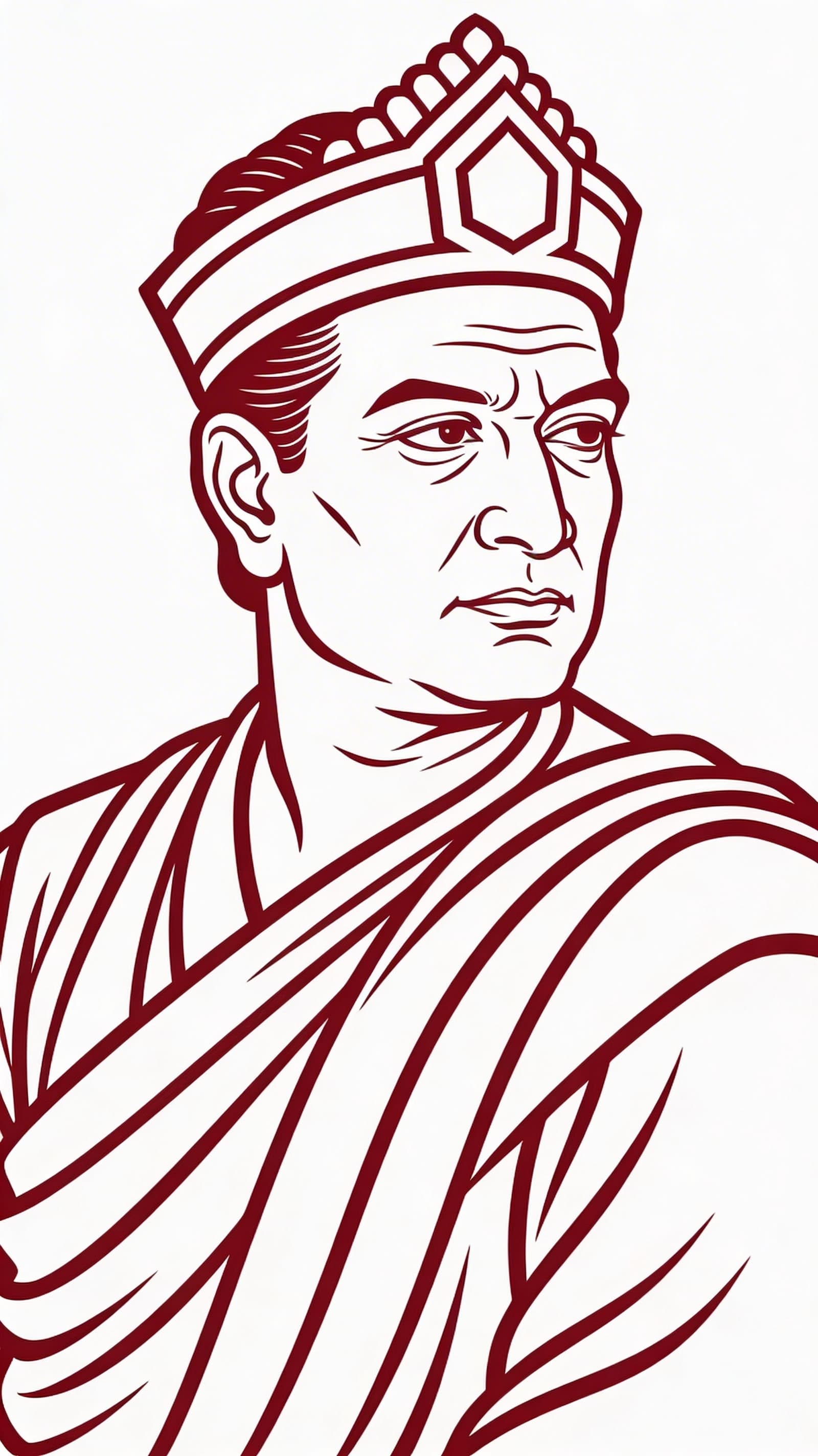
Manadeva I (Mandev )
Manadeva I (also written Mandev or Mandeva) was a seminal Licchavi king of early medieval Nepal whose reign in the 5th century A.D. marks the beginning of securely documented Nepalese political history. Emerging from a lineage remembered as Licchavi Suryavanshi rulers centered in the Kathmandu Valley, he consolidated royal authority over fractious feudatories, expanded his realm from the Kosi River in the east to the Gandaki region in the west, and up to the Himalayan foothills in the north. His Changu Narayan pillar inscription of 464 A.D. is the oldest securely dated stone inscription yet known from Nepal, anchoring the chronology of the Licchavi era and presenting him as a conquering yet dharmic king devoted to Vishnu while also patronizing Buddhist institutions. Through military campaigns, coinage (Mananka), the palace of Managriha, land grants, and religious endowments, Manadeva transformed the Kathmandu Valley into a more centralized and prosperous polity whose cultural and institutional patterns shaped Nepalese state formation for centuries.
Profile Narrative
Episode 1: A Valley Between Empires
In the middle of the first millennium A.D., the Kathmandu Valley lay at a crossroads of the Himalayan world—linked by trade and pilgrimage routes to the Gangetic plains to the south and Tibet to the north, yet politically fragmented and only loosely documented in surviving sources. Earlier dynasties such as the Gopalas and Kiratas are remembered in later chronicles, but it is with the Licchavi kings that inscriptions, coins, and durable monuments begin to give historians a clearer, textually anchored picture of power and society in Nepal. By the time Manadeva came to the throne, the Licchavis had already established themselves as the dominant ruling house in the valley, claiming an illustrious Suryavanshi lineage and projecting themselves as upholders of dharma amid a dense religious landscape of Shaiva, Vaishnava, and Buddhist communities.
The valley’s political fabric, however, remained delicate. Feudatory chiefs and governors—often referred to as samanta or associated with the Thakuri elite—maintained their own militias and local bases of authority, while the royal court in the emerging capital around Managriha had to negotiate, coax, and at times coerce these local powers into obedience. The institutional forms of Licchavi government—a maharaja at the apex, a powerful council of ministers, and influential aristocratic lineages—were still in the process of taking a stable shape, and the boundaries of the kingdom’s authority waxed and waned with each reign. It was into this unsettled but dynamic world that the figure later remembered as the first fully historical king of Nepal, Manadeva I, would step.
Episode 2: Lineage, Childhood, and a Realm in Mourning
Manadeva was born into the Licchavi royal house as the son of King Dharmadeva, and the genealogies preserved in inscriptions and later chronicles present him as the grandson of Shankardeva and great‑grandson of Vrsadeva, embedding him in a multi‑generation line of rulers whose authority radiated from the Kathmandu Valley. These genealogical claims, which connect the Licchavis to prestigious Suryavanshi traditions, are widely repeated in Nepalese historiography, though historians note that the precise early sequence and external origins of the dynasty remain a matter of scholarly reconstruction and debate rather than fully secure fact.
The details of Manadeva’s childhood are not recorded in contemporary narrative sources, but inscriptions and later chronicles converge on the picture of a prince who lost his father while still young, at a moment when internal tensions in the kingdom were acute. One strand of the Gopalraj Vamsavali tradition, interpreted by some modern scholars, even preserves a dramatic account in which Manadeva is said to have killed his own father Dharmadeva—decapitating him unknowingly or under a ritual pretext near a canal—a story that, while traditionally believed in some retellings, is regarded with caution by historians because it blends legendary and moralizing elements with very sparse corroborating evidence.
What the epigraphic record does make clear is that Dharmadeva died before Manadeva had fully come into his own, and that the young prince’s accession required the steadying presence of his mother, Queen Rajyavati (also written Rajyawati), who chose an unconventional path at her husband’s death. Rather than commit sati—a practice of widow self‑immolation that later narrative sources suggest as a looming expectation—she is portrayed as deciding to live and act as regent alongside her son, a choice that becomes a recurring motif in the political memory of Manadeva’s early reign as a moment when maternal counsel and restraint protected both dynasty and realm.
Episode 3: A Young King and the Crisis of Feudatories
With his father gone, Manadeva was crowned king in his youth, sharing power—at least initially—with his widowed mother, whose presence in the records underlines the precariousness of royal authority at the time. The early years of his rule were marked by a serious challenge from within: the Thakuri governors and local chiefs of the eastern provinces, emboldened by the king’s youth, attempted to break away from Licchavi suzerainty and assert de facto independence.
According to later historical summaries based on inscriptions and genealogies, Manadeva did not respond to this fragmentation with passive tolerance; instead he gathered a substantial army, rallied loyal elements of the court, and marched eastward to confront the rebellious feudatories. The narrative of these campaigns presents him as a decisive and militarily capable ruler who crushed the revolt with enough force that the eastern chiefs were compelled to submit, bowing—literally and figuratively—before the authority of the maharaja.
These early actions had consequences that went beyond immediate battlefield success. By reasserting control over the eastern marches, Manadeva signaled that the Licchavi court in the Kathmandu Valley was not a ceremonial relic but a sovereign center willing to use armed force to maintain the cohesion of its realm. This consolidation of power set a pattern for subsequent Licchavi kings, who would operate in a political environment where aristocratic rivals and local lords remained significant but where the image of a strong, dharmic king curbing their autonomy had been firmly established.
Episode 4: Campaigns to the West and Mapping a Larger Nepal
After stabilizing the east, Manadeva is recorded as turning his attention westward, where a mosaic of small polities and semi‑independent domains lay between the Kathmandu Valley and the middle course of the Gandaki and Kali Gandaki rivers. Inscriptions and later historical syntheses attribute to him the conquest of places remembered as Mallapuri and Nabalpur, among other minor states, as he pushed the frontiers of Licchavi authority further into what is now central and western Nepal.
The exact identification of Mallapuri and Nabalpur with modern locations remains debated among scholars, but the geographic pattern described in the sources is clear: under Manadeva, Licchavi control extended up to the Himalayas in the north, beyond the Gandaki basin in the west, and eastward to the Kosi River, creating a realm considerably larger than the immediate Kathmandu Valley. This expansion did not necessarily mean direct bureaucratic control over every village; rather, it likely involved a re‑layering of allegiances, tributary arrangements, and the incorporation of local chiefs into a broader Licchavi‑centered political order symbolized by the king’s victories and religious merit.
By situating the Kathmandu Valley as the nerve center of a territory straddling major river systems and trade routes, Manadeva’s campaigns helped to knit together disparate regions into an emergent conception of “Nepal” that, while not identical to the modern state, foreshadowed later east–west unifications. The conquest narratives inscribed in stone thus served a dual function: they recorded specific acts of warfare and subjugation, and they also projected a political geography in which the Licchavi maharaja occupied the apex of a widening hierarchy of power.
Episode 5: Managriha, Mananka, and the Architecture of Power
If Manadeva’s armies defined the outer edges of his realm, his most enduring internal monument was the palace and administrative complex known as Managriha, which sources describe as the principal royal residence and center of governance for subsequent Licchavi kings. Built in the Kathmandu Valley—likely in the area that would remain the political heart of Nepal for centuries—Managriha embodied the shift from a more peripatetic or loosely organized kingship to a courtly center where royal authority, bureaucratic routines, and religious patronage could be coordinated.
Alongside the palace, Manadeva is credited with issuing a distinctive series of coins known as Mananka, which are among the earliest named coinages associated with a Nepalese king and testify to a monetized economy engaged in regional trade. The spread of such coinage, bearing royal symbols and inscriptions, not only facilitated commercial transactions but also carried the image and name of the king into markets and communities far from the capital, reinforcing the perception of a single sovereign under whose auspices economic life unfolded.
Under Manadeva and his successors, land grants to religious institutions and local elites—often recorded in stone inscriptions—helped to stabilize revenue, support temple and monastic infrastructures, and bind influential families to the royal project. Systems of endowed land management, later referred to as guthi, have roots traced by scholars back to the Licchavi era, where they already functioned as key mechanisms for maintaining temples, shrines, and public rest houses while intertwining local religious life with long‑term fiscal and social obligations. In this sense, Manadeva’s reign contributed to institutional patterns of property and piety whose echoes are still visible in contemporary Nepalese society.
Episode 6: Vishnu’s Devotee and a Syncretic Religious Landscape
Religious life under Manadeva was anything but simple. Inscriptions and later analyses agree that he was personally devoted to Vishnu, commissioning famous Vaishnava images and promoting a royal ideology in which the king’s virtues and victories were framed as aligned with the sustaining power of that deity. Among the most celebrated material testimonies of his piety is the stone pillar inscription at Changu Narayan—dated 464 A.D.—which stands beside one of the valley’s great Vishnu temples and is widely recognized as Nepal’s oldest securely dated epigraphic record.
The Changu Narayan inscription, now carefully studied by epigraphists, extols Manadeva’s conquests and virtues while also recording land grants and ritual acts, thereby intertwining royal power, religious merit, and social obligations in a single text. It portrays him as a righteous, generous king who offers donations to ensure both worldly order and spiritual benefit, in line with broader South Asian notions of the dharmic monarch whose legitimacy rests as much on patronage and justice as on sheer force.
Yet Manadeva’s religious patronage was not confined to Vaishnavism. Scholarly syntheses of Licchavi inscriptions note that, although he foregrounded Vishnu, he also consecrated images dedicated to Shiva and established or endowed at least one Buddhist monastery and stupas, reflecting the valley’s long‑standing Buddhist presence. This pattern of multi‑sectarian royal support—where Hindu and Buddhist institutions alike received land, donations, and protective attention from the throne—helped to sustain the syncretic, overlapping religious environment for which the Kathmandu Valley later became famous.
Episode 7: Law, Land, and Everyday Subjects
While surviving inscriptions from Manadeva’s reign are not exhaustive administrative manuals, they offer glimpses into how law, land, and social order were imagined in his time. Grant records typically specify boundaries, obligations, and exemptions, and they sometimes invoke curses against those who might violate the terms, indicating concerns with the stability of property rights and the enforceability of royal decrees.
The consolidation of territory through conquest was thus followed by a quieter, but equally consequential, consolidation of rights, duties, and hierarchies on the ground. Beneficiaries of royal favor—whether Brahmins receiving tax‑free lands, monasteries endowed with revenue, or local notables entrusted with management—became stakeholders in a social order that tied their fortunes to the endurance of Licchavi power. In return, the king’s reputation as a just ruler rested on his ability to protect these arrangements, punish wrongdoing, and embody the ideal of a guardian of dharma whose actions maintained cosmic and social balance.
Economically, the use of coinage, the location of the capital along trans‑Himalayan trade routes, and the patronage of market‑adjacent structures such as rest houses (sattals) and temples suggest a society where commerce, pilgrimage, and ritual intersected. Later architectural and textual studies show how such spaces functioned as “third places” of sociability, governance, and religious life, rooted in patterns that can be traced back to the Licchavi period and arguably already forming under kings like Manadeva.
Episode 8: Legend, Atonement, and the Moral Imagination
Around the bare factual framework of Manadeva’s reign, later chronicles and popular retellings have woven powerful legends that speak to the moral imagination of Nepalese society. One such story, preserved in versions of the Gopalraj Vamsavali and echoed in modern narratives, holds that Manadeva unintentionally killed his own father, Dharmadeva—sometimes depicted as obeying a command to strike a person whose face was concealed, only to discover the victim was his father. In these accounts, the young king, horrified, is said to have renounced the throne temporarily, wandering to a monastery such as the Gum‑vihara near Sankhu to undertake ascetic penance before eventually returning to rule.
Historians debate the literal accuracy of this patricide narrative, noting that it may encode symbolic themes of generational conflict, karmic burden, and moral testing rather than straightforward reportage of events. Nonetheless, the persistence of the story in Nepalese historical memory underlines how Manadeva came to embody not only political authority but also a complex moral lesson: even a great king could be shadowed by grave sin, and true kingship required repentance, self‑discipline, and the re‑establishment of right order.
Another widely cited motif emphasizes the role of his mother, Rajyavati, who is portrayed as rejecting sati in favor of protecting her son and the kingdom, thereby elevating her to an exemplar of wise queenship and maternal courage. Together, these narratives contribute to a quasi‑didactic image of Manadeva’s court, where the endurance of the dynasty depends as much on ethical choices, loyalty, and restraint as on battlefield prowess.
Episode 9: Long Reign, Succession, and the Shape of an Era
Modern reconstructions based on inscriptions and dynastic lists agree that Manadeva enjoyed a long reign—on the order of four decades—during which no serious internal challenger succeeded in displacing him. Sources often place his rule between about 464 and 505 A.D., and while minor chronological variations exist, the stability implied by this span contrasts with the shorter and more turbulent reigns that bracket other points in Licchavi history.
He was succeeded by Mahideva (Mahideva or Mahideva I in some lists), after which a sequence of Licchavi rulers—Vasantadeva, Vamanadeva, Ramadeva, and others—continued to govern the Kathmandu Valley for roughly three more centuries. The institutional structures strengthened under Manadeva—centralized administration at Managriha, the use of royal coinage, the embedding of religious endowments in legal documents, and the projection of a territorially expansive, dharmic kingship—provided a durable template that later monarchs modified but did not discard.
In this sense, Manadeva’s significance lies less in any single spectacular event than in the cumulative effect of his reign on the contours of Nepalese statehood. By the time later figures such as Amshuverma and Narendradeva confronted new geopolitical challenges, they did so from within an institutional and symbolic world that Manadeva had helped to shape: a world where the Kathmandu Valley was the presumptive heart of power, where inscriptions and coins articulated authority, and where kingship was defined by a blend of military strength, religious patronage, and concern for dharmic order.
Episode 10: Memory, Historiography, and the "First Historical King"
Because the Changu Narayan pillar inscription provides a precise date—464 A.D.—and a rich narrative of Manadeva’s deeds, many historians regard him as the first fully historical king of Nepal whose reign can be firmly anchored in external chronology rather than only in later legendary lists. Earlier rulers such as Jayavarman and Supuspa Dev appear in inscriptions and chronicles, and an inscription from Maligaon has pushed the epigraphic record further back, but their sequences and exact positions remain more contested, whereas Manadeva’s place in the mid‑5th century is widely accepted.
Modern Nepalese historiography and school curricula often highlight Manadeva as a model of just and capable kingship, emphasizing his suppression of rebellious lords, territorial expansion, patronage of temples such as Changu Narayan, and introduction of coinage as markers of a flourishing early state. At the same time, scholarly work on Licchavi inscriptions, coins, and religious institutions has situated him within broader South Asian patterns of regional monarchy, showing how his reign both resembled and diverged from contemporary polities in the Gangetic plains and beyond.
For students of Nepal’s political evolution—from monarchy through the Panchayat system to the present federal democratic republic—Manadeva’s era offers a crucial early chapter. It reveals how ideas of kingship, territory, law, and religious patronage were first articulated in durable, datable forms, and how a ruler in the Kathmandu Valley could imagine and project a domain stretching from river to river and mountain to mountain. In the stones of Changu Narayan, the lines of land grants, and the legends of remorse and wisdom, the figure of Manadeva endures as both a historical monarch and a touchstone for thinking about what it has meant, across the centuries, to rule in the land now called Nepal.