
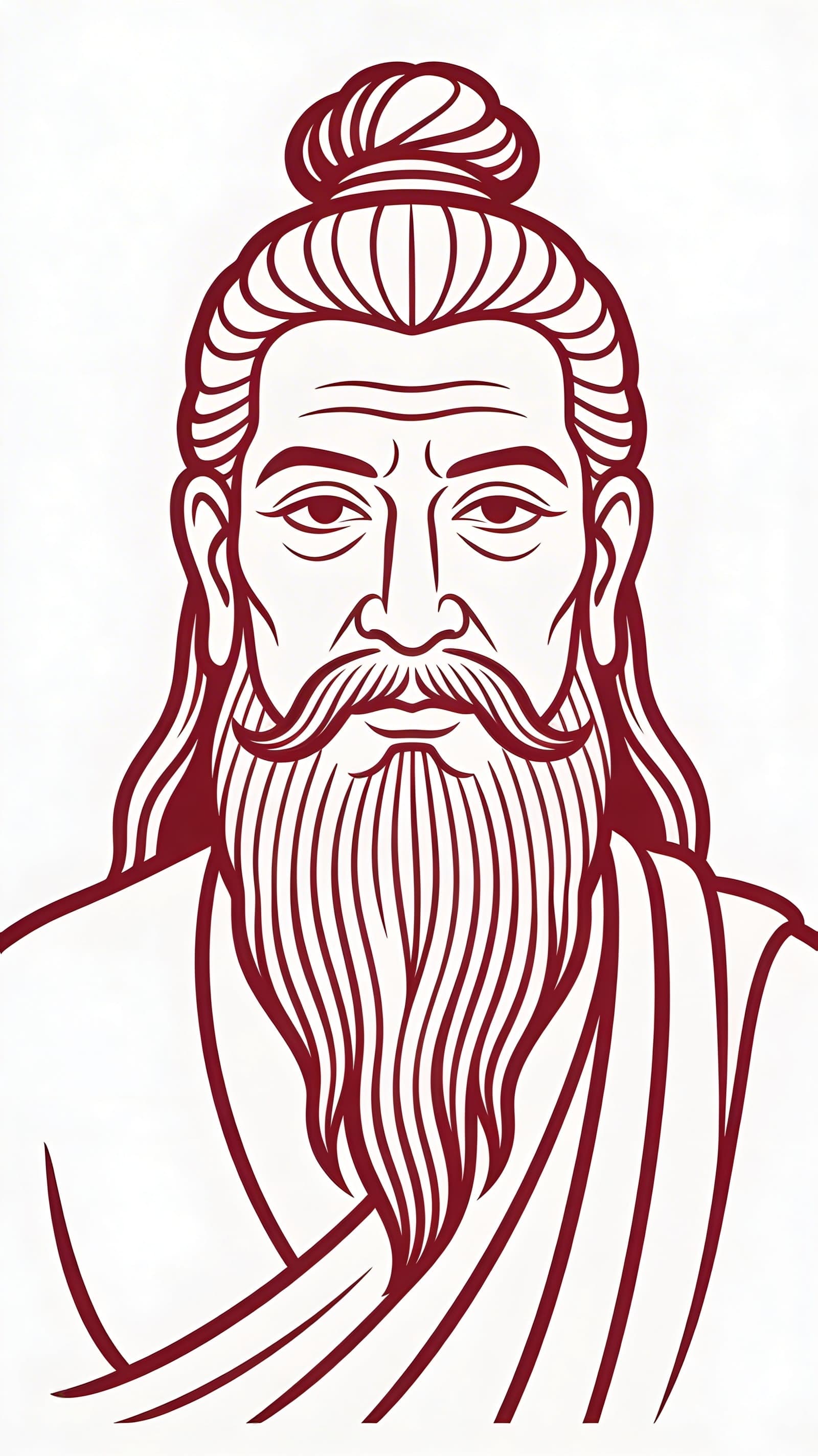
Vedavyasa (Vyasa)
Krishna Dvaipayana, widely revered as Vedavyasa or simply Vyasa, is the legendary sage traditionally credited with dividing the single primordial Veda into the four canonical collections and composing the epic Mahabharata. He is also associated with the authorship or compilation of the Brahma Sutras and the eighteen major Puranas, making him one of the foundational architects of Hindu scriptural tradition. As the son of the sage Parashara and Satyavati and the biological father of Dhritarashtra, Pandu, and Vidura, Vyasa stands both as a spiritual lawgiver and as an ancestor of the very dynasty whose tragic civil war he narrates. While modern historians regard him as a mythic or composite figure whose exact historical dates cannot be established, his literary and theological persona has shaped religious life, philosophy, and political imagination from the Indo-Gangetic plains to the Himalayan kingdoms, including Nepal, for many centuries.
Profile Narrative
Episode 1: A Child of River, Fishers, and Sages
In the oldest narrative layers of the Mahabharata and allied Puranic texts, Vyasa first appears not as a distant god but as a living sage within the very story he would later be credited with composing. According to these traditions, his mother Satyavati was raised as the daughter of a fisherman chief on the banks of the Yamuna, ferrying people across the river, while his father Parashara was a wandering rishi of great austerity and learning. Their meeting on a river boat, where Parashara sought to cross in haste to attend a sacrifice, becomes the scene of Vyasa’s miraculous conception and birth.
Texts such as the Vishnu Purana and later narrative retellings relate that Satyavati conceived and immediately gave birth on an island in the Yamuna. Because he was born on an island, he received the epithet Dvaipayana ("island-born"), and his dark complexion gave him the name Krishna, which together with his later work on the scriptures yielded the honorific Vedavyasa, "the one who arranged the Veda". The child-sage is described as speaking reassuringly to his mother at birth, promising that he would return whenever she needed him, before leaving for the forests to undertake tapasya and scriptural study.
Outside the pan-Indic textual tradition, regional memories add their own geographies to his origin. A strong local tradition in present-day Nepal, for example, venerates Damauli in Tanahun District as Vyasa’s earthly birthplace and identifies caves there as sites where he meditated and composed parts of the Mahabharata. While mainstream Sanskrit sources emphasise the Yamuna island, these Nepalese claims reflect how Himalayan communities have woven Vyasa into their own sacred landscapes without contradicting the broader mythic frame.
Episode 2: Student of Eternal Knowledge
After leaving his mother, the young Krishna Dvaipayana is portrayed as a tireless seeker who spends years in forests and hermitages, mastering the vast oral corpus of Vedic hymns, sacrificial procedures, and emerging philosophical speculations. Later tradition holds that he learned not only from human teachers but from exalted sages such as the four Kumaras, Narada, and even Brahma himself, symbolizing that his authority rested on a chain of primordial wisdom.
The world in which Vyasa moved was the late Vedic age, understood in Hindu cosmology as the Dvapara Yuga, a time when, according to tradition, human lifespans and moral clarity were already declining. As ritual specialists and kings struggled to navigate this more complex world, Vedic knowledge remained scattered across numerous family lineages and schools (shakhas), preserved entirely by memory and transmitted through precise recitation. The risk of loss through war, migration, or simple forgetfulness weighed heavily on conservative minds.
In this setting, Vyasa’s life mission emerges: to stabilize, organize, and interpret the inherited revelation so that humans of a spiritually weakened age could still access the core of dharma. His tapasya (austerity), meditation, and study are depicted not as private self-improvement but as a preparation for a colossal cultural task that would determine how future generations—India-wide and, eventually, in lands like Nepal—would hear, chant, and understand the Veda.
Episode 3: Divider of the Veda and Architect of Scripture
Hindu tradition unanimously credits Vyasa with a decisive intervention in the history of sacred knowledge: he "divided" the single undifferentiated Veda into four structured collections now known as the Rig, Yajur, Sama, and Atharva Vedas. The purpose of this act was not to fragment revelation but to classify its hymns and formulas according to their liturgical use—recitation in praise, prose formulas for sacrifice, melodies, and more esoteric ritual material—so that priests of diminished memory could still perform complex rites correctly.
Traditional accounts describe Vyasa assigning each Veda to a leading disciple, thereby creating new Vedic lineages that would specialise in and preserve a particular collection. This systematisation had immense socio-religious consequences: it stabilized priestly education, standardized rituals across large territories, and allowed later commentators and philosophers—Mimamsakas, Vedantins, and others—to work from relatively fixed textual corpora rather than a fluid and partly forgotten oral sea.
According to later biographies, once the Vedas were classified, Vyasa turned to composing complementary bodies of literature to make their message accessible to wider audiences. He is traditionally associated with the eighteen Mahapuranas, narrative-theological works that embed cosmology, ethics, royal ideology, and pilgrimage geographies in story form, including the Bhagavata Purana whose narrator is his own son Shuka. Finally, he is credited with the Brahma Sutras, a compact set of around 555 aphorisms that crystallise Upanishadic theology and later became the central text for Vedanta schools from Shankara to Ramanuja and Madhva.
Episode 4: Ancestor of the Kurus – Politics, Niyoga, and a Dynasty’s Fate
Vyasa’s story is unique among world scriptural authors in that he is simultaneously cast as a lawgiver and as a blood ancestor of the royal house whose collapse he narrates. His mother Satyavati, after her encounter with Parashara, later married King Shantanu of Hastinapur, becoming queen and stepmother to the famed warrior Bhishma. When Satyavati’s sons Chitrangada and Vichitravirya died without a stable line of heirs, the royal house faced a succession crisis that threatened both political order and the ritual obligations of the Kuru dynasty.
It is here that the practice of niyoga—appointed levirate procreation to extend a family line—enters the narrative. Summoning her first-born son from the forest, Satyavati asks Vyasa to beget heirs on the widows of Vichitravirya in order to preserve the royal lineage and the continuity of ancestral rites. From these unions are born Dhritarashtra, Pandu, and Vidura, who will later stand at the centre of the Mahabharata’s political and moral drama: Dhritarashtra as the blind king, Pandu as the nominal father of the Pandavas, and Vidura as the wise counsellor whose advice is often ignored.
By making Vyasa both progenitor and narrator, the epic presents him as uniquely placed to diagnose the degeneration of royal dharma from within. He is not an external critic but a grandfather watching his descendants slide toward catastrophe despite repeated warnings and scriptural instruction. This dual identity also intensifies the epic’s moral questions: if even the family of the sage who ordered the Vedas cannot escape greed, rivalry, and civil war, then the struggle to uphold dharma is shown to be universal rather than confined to any single lineage or land.
Episode 5: The Mahabharata, Ganesha’s Pen, and the Song of the Gita
Tradition holds that, seeing the Kuru crisis and its lessons as too momentous to be left to fading memory, Vyasa resolved to cast the entire saga—its genealogies, battles, and philosophical dialogues—into a single vast composition. The result is the Mahabharata, an eighteen-parva epic of roughly one hundred thousand verses, often described as the longest poem in world literature and deliberately framed as "what is found here may be found elsewhere; what is not found here is found nowhere".
Because no ordinary scribe could keep pace with such a recitation, the gods themselves are said to have intervened. Later devotional and didactic texts recount that Brahma advised Vyasa to seek out Ganesha as a divine scribe; Ganesha agreed on the condition that Vyasa would dictate without pause, while Vyasa added the counter-condition that Ganesha must fully understand each verse before writing it. This ingenious arrangement, according to tradition, allowed Vyasa brief moments to compose complex sections while Ganesha pondered their meaning, and when the writing instrument broke, Ganesha famously snapped off his own tusk to continue inscribing the epic, symbolising sacrifice in the service of sacred knowledge.
Within this gigantic narrative, Vyasa places the Bhagavad Gita—a dialogue of about seven hundred verses between Krishna and the warrior Arjuna on the battlefield of Kurukshetra, immediately before an eighteen-day war in which seven army divisions (akshauhinis) of the Pandavas face eleven of the Kauravas. Through the Gita’s teaching on duty, devotion, and the nature of action, Vyasa turns a dynastic conflict into a timeless exploration of moral responsibility that would influence not only Indian thought but, much later, reform and freedom movements from India to Nepal and beyond.
Episode 6: Puranas, Brahma Sutras, and the Vision of a Complete Dharma
Beyond the epic and the Vedas, the tradition of Vedavyasa grows to encompass almost the entire classical Hindu library. Many accounts credit him with compiling or authoring the eighteen major Puranas, which weave together theology, mythology, king-lists, and pilgrimage lore into narratives meant for recitation among broad publics rather than just priests. These works—especially the Bhagavata Purana, in which Vyasa’s son Shuka narrates the deeds of Krishna—translate abstract Vedic and Upanishadic ideas into emotionally powerful stories about devotion, cosmic cycles, and the rise and fall of kingdoms.
The Brahma Sutras, also traditionally ascribed to Vyasa, perform a complementary intellectual task. Organised into four chapters and approximately 555 aphorisms, they systematise Upanishadic reflections on ultimate reality and the soul, providing a terse blueprint that later Vedanta philosophers would expand into full theological systems. In this way, Vyasa’s persona comes to sit at the junction of narrative and philosophy, ritual and reflection, law and liberation.
For the political cultures of South Asia, including the Kathmandu Valley and the hill polities that would later form modern Nepal, this integrated vision of dharma had far-reaching consequences. Puranic models of righteous kingship, pilgrimage networks, and cosmic geography informed how rulers understood their own authority, how subjects interpreted natural disasters and dynastic change, and how elites legitimated reforms or resistances by appealing to scriptural precedent rather than arbitrary will.
Episode 7: Himalayan Presence, Guru Purnima, and the Immortal Sage
Although the historical person of Vyasa cannot be fixed to precise Gregorian dates, his presence in the religious life of the subcontinent is both continuous and vivid. Hindu tradition counts him among the seven Chiranjivis—the long-lived or immortal beings—who remain present in subtle form through the ages, available to guide those who seek truth. His birthday is celebrated across India and Nepal as Guru Purnima, on the full moon of the month of Ashadha, when disciples honour both their immediate teachers and the lineage of wisdom symbolised by Vyasa.
In the Himalayan region, numerous caves, shrines, and river confluences are linked to Vyasa’s name, including sites in present-day Uttarakhand and in Nepal’s Tanahun District, where local traditions hold that he meditated and composed parts of his works. Whether or not these precise identifications can be historically verified, they show how communities localise a pan-Indic sage into their own terrain, inscribing his memory into their mountains and rivers.
From a historian’s standpoint, Vyasa is best understood as a layered figure: a possible ancient seer around whom successive generations of authors, editors, and ritualists aggregated their own contributions to Vedic, epic, and Puranic literature. Yet within Hindu and Nepali religious consciousness, he remains a single, luminous guru whose life story, works, and family drama model the intertwining of scripture, politics, and personal struggle. In that sense, the authority of Vedavyasa is less about verifiable dates than about the enduring capacity of his attributed texts to organise how societies think about duty, power, and liberation across millennia.