
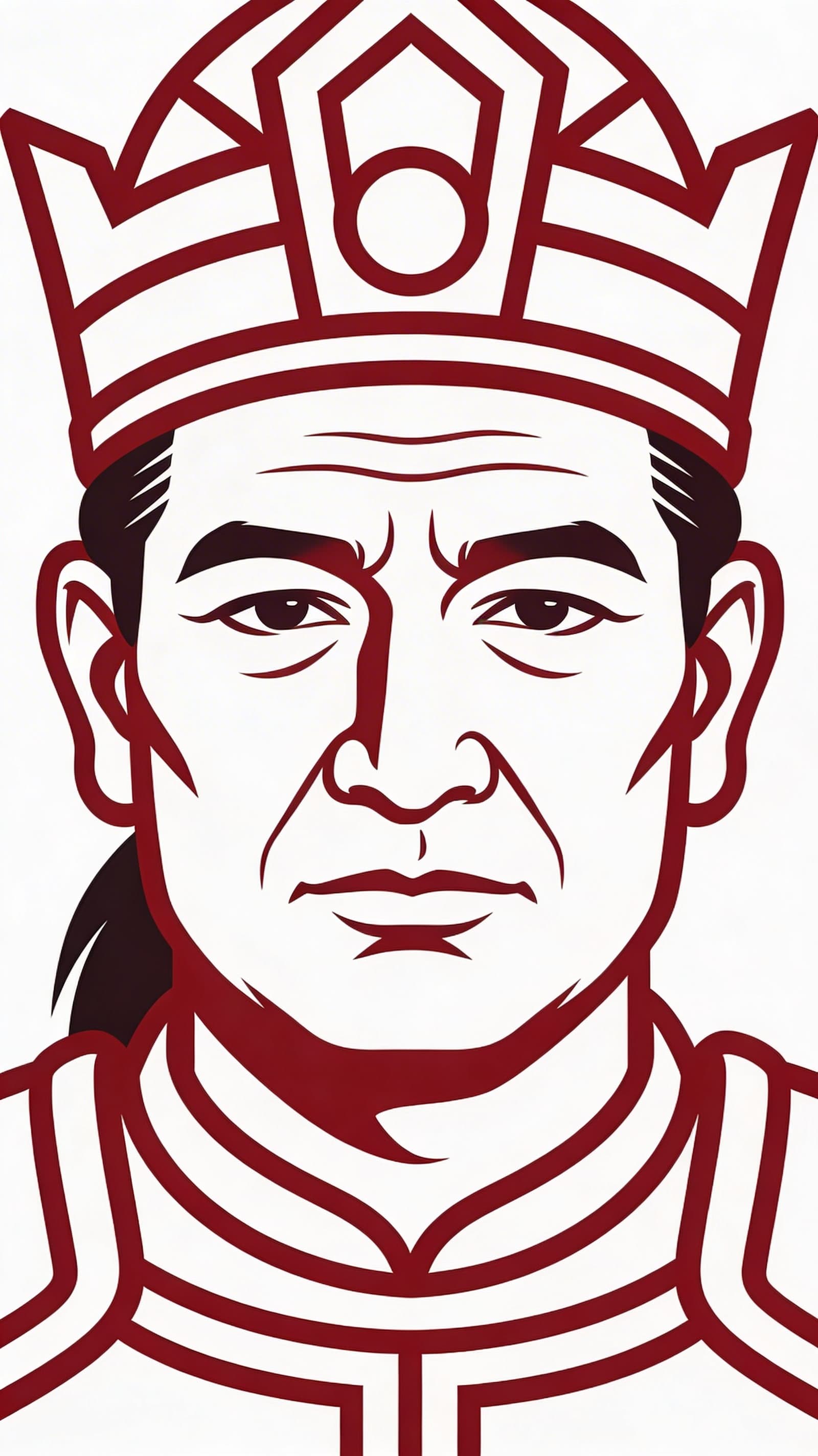
Yalambar (King Yalamber)
King Yalambar, also known as Yalamber or Yellung Hang, is remembered in Nepali chronicles and Kirat oral tradition as the first historical ruler of the Kirat dynasty in Nepal, who conquered the Kathmandu Valley and established a powerful hill kingdom stretching from the Trishuli River in the west to the Teesta River in the east. Traditional Bansawali genealogies place his rise around the 8th–9th century BCE, crediting him with defeating the last Ahir or Mahispal ruler Bhuban Singh and founding a line of roughly 29 Kirat kings who ruled for about 1,200 years before the advent of the Licchavi dynasty. Later Hindu–Buddhist legend fuses Yalambar with Barbarika of the Mahabharata, claiming that Lord Krishna took his head before the Kurukshetra war and that this severed head is now worshipped in Kathmandu as the sky-god Akash Bhairav during the Indra Jatra festival, making him a rare figure who stands at the crossroads of myth, religion, and early state formation in Nepal.
Profile Narrative
Episode 1: From Eastern Hills to the Threshold of History
Long before the Lichhavis and Mallas carved their names in stone, the peoples later known as the Kirats were already moving along the ridges and river valleys of the eastern Himalaya, herding livestock, hunting in dense forests, and trading salt, wool, and metals between the Tibetan plateau and the Gangetic plains. Modern historians generally view them as an indigenous Tibeto-Burman group who migrated westward from present-day eastern Nepal, Sikkim, and Bhutan, gradually pushing toward the fertile Kathmandu Valley that controlled key north–south trade routes.
Within this broad movement, Yalambar—also styled Yalamber, Yellung Hang, or Yalamver in later texts—emerges as the first Kirat chieftain to be named consistently across Bansawali genealogies and popular histories. These chronicles, compiled many centuries later, do not give a verifiable birth date, but they agree that he belonged to the Yellung clan and that his career marks the transition from purely tribal hill chiefdoms to a recognizable early kingdom centered on the Kathmandu Valley.
By the time Yalambar appears in the narrative, the valley itself was already the seat of earlier dynasties referred to as Gopal, Mahispal, or Ahir in different traditions, probably semi-mythical pastoral and agrarian rulers associated with cowherding communities. In both Kirat and later Newar memory, the old order is portrayed as weakened—unable to fully control the surrounding hills or the trade routes threading north to Tibet and south to the plains—creating a vacuum into which this ambitious hill war leader could move.
Episode 2: The Conquest of the Kathmandu Valley
Traditional Bansawali accounts and modern summaries agree on the core storyline: Yalambar launched a decisive campaign against Bhuban Singh (or Bhuvan Singh), described as the last Ahir or Mahispal king of the valley. The details of the campaign—routes, exact battles, and tactics—are not preserved in primary military records, but Kirat narratives emphasize disciplined hill archers, knowledge of rugged terrain, and coordinated attacks from surrounding ridges to seize the valley floor.
According to these chronicles, Yalambar defeated Bhuban Singh in battle and thereby extinguished the older line of cowherd kings, inaugurating Kirat political dominance. One strand of tradition claims that he first ruled from the western rim of the valley at Thankot, while another, cited in modern reconstructions, states that he made Matatirtha—likewise on the southwestern edge—his capital; both sites reflect a preference for defensible hill spurs overlooking the valley’s rich alluvial floor.
From this new power base, Yalambar is said to have extended his authority eastward and westward, welding distinct Kirat clans and local communities into a looser but recognizably unified kingdom. Later lists of Kirat kings describe his realm as stretching from the Trishuli River in the west to the Teesta River in the east, an arc that would have encompassed today’s Kathmandu Valley, much of eastern Nepal, and corridors into Sikkim and northern Bengal, though the exact degree of control over distant areas likely varied over time.
Episode 3: Founding the Kirat State – Law, Trade, and Worship
While the institutions of the mature Kirat state developed over many generations, later historical syntheses explicitly credit Yalambar’s founding reign with setting patterns that shaped Nepal’s early political and social order. Under the Kirat dynasty that followed him, Nepal made notable advances in art and architecture, trade and commerce, and the rudiments of formal justice, a trajectory most scholars see as rooted in the consolidation of the valley under its first Kirat ruler.
Kirat sources and derivative histories describe a society in which men and women enjoyed relatively equal status in public life, at least compared to later feudal orders, and in which local law-courts operated at multiple sites such as Kuther, Shuli, Lingual, and Mapchok to adjudicate disputes and punish crime severely. Though these practices are better documented for later kings, the very existence of such a network suggests that Yalambar’s unification of the valley created the political space in which early administrative norms could spread from hill communities into a centralized framework.
Economically, the Kirats combined agriculture, animal husbandry, and trade. The fertile Kathmandu Valley allowed cultivation of millet, barley, wheat, and rice, while upland areas supported herds of sheep and goats, and Kirat traders exported wool, wooden goods, and medicinal herbs to markets in Magadha and beyond; Kautilya’s Arthashastra, compiled centuries later, famously praises woolen blankets from Nepal as valued commodities, evidence that such trade routes were already active during or soon after the Kirat period.
Religiously, the Kirats worshipped Lord Shiva alongside serpents, trees, stones, and ancestral spirits, blending early Shaivism with strong elements of animism and nature veneration. Later tradition associates early forms of Pashupatinath worship and shrines like Kirateshwar Mahadev with Kirat devotion, though the precise dating of these cults remains debated; what is clear is that the dynasty founded by Yalambar helped entrench a syncretic religious landscape into which Buddhism would later be woven.
Episode 4: Yalambar and the World of the Mahabharata
Perhaps the most dramatic and contested part of Yalambar’s story is his connection to the Mahabharata, the great Sanskrit epic of the Kurukshetra war. Some Nepali and pan-Indian devotional sources identify him with Barbarika, the mighty warrior grandson of Bhima, while others treat him as a distinct Kirat king whose fate nonetheless intersects Krishna’s strategies before the battle.
According to a widely circulated narrative, Yalambar prepared to leave his Himalayan kingdom and travel to Kurukshetra at the start of the war, vowing to support the side that appeared to be losing, in keeping with a warrior’s dharma to protect the oppressed. Aware of both his strength and his vow, Lord Krishna feared that the arrival of such an ally—especially if he sided with the Kauravas—would prolong the conflict and upset the delicate moral calculus of the struggle.
In this legend, Krishna intercepts Yalambar on his journey and, through a mixture of diplomacy and divine authority, asks him for his head as a boon, promising to place it upon a high hill so that the king can witness the entire war without taking part. Yalambar consents, and his severed head watches as Krishna’s counsel and strategy guide the Pandavas to victory; when the brothers later quarrel over who deserves credit, Krishna invites Yalambar’s head to judge, and it is this impartial witness who declares that the victory belongs above all to Krishna.
Historically, scholars point out that the dates assigned to the Mahabharata war in various traditions (ranging from the late Bronze Age to mythic third millennium BCE) do not fit neatly with the c. 800 BCE horizon usually given for the start of Kirat rule, and the critical Sanskrit text of the Mahabharata does not explicitly name Yalambar. As a result, many historians treat this story as a later theological and cultural linkage rather than direct evidence of his chronological participation in the epic war, while still recognizing its enormous importance in how communities remember him.
Episode 5: Akash Bhairav, Indra Jatra, and the Afterlife of a Severed Head
The story of Yalambar’s head does not end on the plain of Kurukshetra. In the Kathmandu Valley, a powerful cult grew around the deity Akash Bhairav, whose large blue visage is displayed annually above Indrachowk during the Indra Jatra festival and venerated as a sky god and protector, especially of children. Local legend explicitly identifies this head with that of Kirat King Yalambar (or Barbarika), carried miraculously through the sky from Kurukshetra to the valley and enshrined as a divine guardian.
Multiple modern accounts—ranging from scholarly essays on Kathmandu’s Bhairav cults to popular history blogs—repeat the association between Akash Bhairav, Yalambar, and Barbarika, noting that in Rajasthan the same figure is worshipped as Khatushyamji and in Kathmandu as the Aaju of Indrachowk. While the material sculpture itself is far younger than the mythic time it commemorates, the persistence of this identification shows how Yalambar’s memory migrated from royal genealogy into the religious life of the city he is said to have once conquered.
During Indra Jatra, the head of Akash Bhairav is decorated with silver ornaments and garlands, and ritual dances and offerings are performed before it, acts which, in the logic of local tradition, are also offerings to the watchful Kirat king whose sacrifice enabled a righteous conclusion to the Mahabharata war. In this way, Yalambar’s story becomes part of Kathmandu’s annual ritual cycle, tying the valley’s contemporary Newar culture back to an early hill warrior whose historical contours remain hazy but whose legendary presence feels vividly alive.
Episode 6: A Dynasty of Twenty-Nine Kings and the Long Shadow of a Founder
Beyond his own life, Yalambar’s greatest historical significance lies in the dynasty he is said to have founded. Bansawali lists and modern syntheses generally attribute around 29 Kirat kings and roughly 1,100–1,225 years of rule to this line, from about 800–900 BCE to around 300 CE, when the Licchavis take over political leadership in the valley. Names such as Pari (Pavi) Hang, Skandhar Hang, Humati, Jitedasti, Patuka, Sthunko, and Gasti populate these lists, though the details of their individual reigns are only partially recoverable.
Over these centuries, the Kirat realm is portrayed as expanding its urban centers—Malatirtha, Shankhamul, Thankot, Bhaktapur (Khopung), Sanga, Teku, and others—and deepening its engagement with long-distance trade and religious pluralism. Later tradition even credits a Kirat king (Jitedasti or Stungko, depending on the source) with welcoming Gautam Buddha to the valley and another with receiving the Mauryan emperor Ashoka, though the precise historicity and chronology of these encounters remain debated.
Some modern Kirat writers argue that Yalambar may have been not the first but the last fully remembered king of an even older, largely forgotten Kirat lineage, pointing to the antiquity of Kirat presence in eastern Nepal and the likelihood of earlier unnamed rulers. However, both older chronicles and mainstream reference works on Nepali history still present him as the founding monarch of the Kirat dynasty in the valley, a convention that has become deeply embedded in school curricula and public discourse.
Episode 7: Memory, Identity, and the Limits of Historical Certainty
Because Yalambar’s story is preserved mainly in later chronicles, oral traditions, and religious legend rather than in contemporary inscriptions or securely dated archaeological layers, modern historians approach him as a liminal figure at the edge of verifiable history. There is broad agreement that a Kirat dynasty ruled the Kathmandu Valley for many centuries before the Licchavis and that early Kirat rulers played a crucial role in knitting together eastern Himalayan communities and valley agriculture and trade, but details of individual lives—including Yalambar’s exact dates—remain uncertain.
Yet for many communities—especially Kirat peoples such as the Limbu, Rai, and Yakkha, as well as Newar residents of Kathmandu—the question of his literal chronology is less important than the symbolic work his story performs. As a warrior who defeats an older order, unites hill tribes, is linked to the moral drama of the Mahabharata, and is remembered as a divine protector of a great city, Yalambar embodies ideas of courage, sacrifice, and rightful rule that continue to inform how Nepalis imagine their own deep past.
In this sense, King Yalambar stands not only as a possible early monarch in Nepal’s long line of rulers, but also as a narrative bridge—connecting Kirat ethnic memory with valley urban culture, pre-Licchavi political formations with later classical dynasties, and mythic Sanskrit epics with the lived ritual calendar of modern Kathmandu. His life, half veiled by legend, remains central to understanding how Nepalese society has woven together diverse peoples, beliefs, and landscapes into a shared, if contested, story of origins.