Background
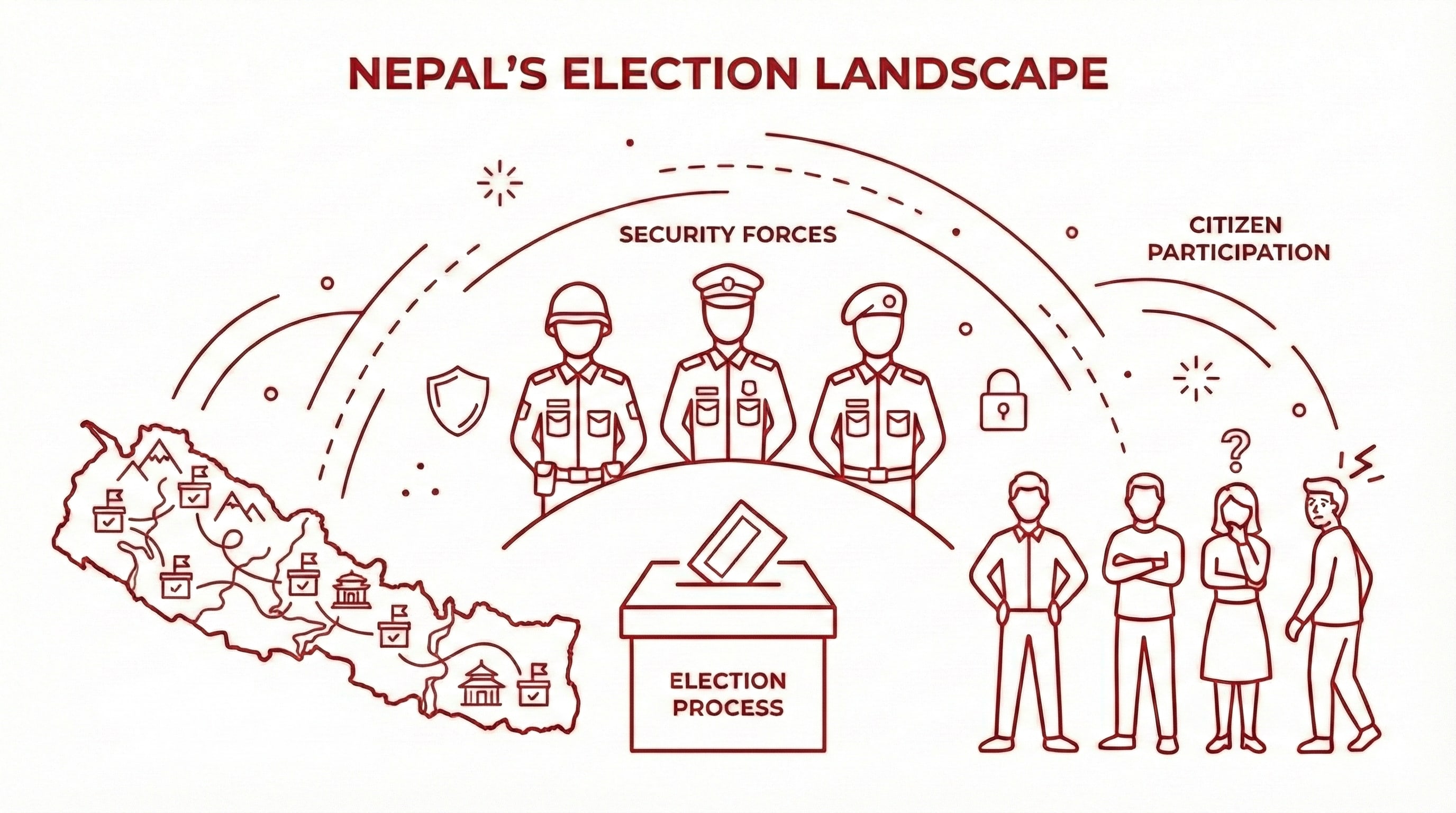
The 2026 House of Representatives election will be the first national vote since the Gen Z protests of September 2025, which shook public confidence in state institutions and forced a rapid political reset. In response, the government and the Election Commission of Nepal (ECN) have treated security as a central pillar of election preparation. An Integrated Election Security Plan, 2082 has been approved, bringing together the Nepali Army, Nepal Police, Armed Police Force, National Investigation Department and a large contingent of temporary election police.
Public briefings and media reporting suggest that roughly 338,000 security personnel will be deployed nationwide. Of these, around 79,700 belong to the Nepali Army, which has already begun field deployment one month before polling day. Temporary 'election police' have received appointment letters and are undergoing training, while district security committees are mapping polling centres by risk level. At the same time, human rights institutions and civil society groups are watching closely, remembering both past abuses and past episodes where weak security enabled violence and intimidation.
This election is therefore not just a test of who wins power; it is a test of how a traumatised state manages fear, force and fairness after a period of unrest.
What Has Changed
One clear change is the timing and visibility of security deployment. In previous federal elections, heavy deployments were often concentrated around polling day itself. This time, the Nepali Army has been ordered into the field a full month in advance to establish base camps, patrol surrounding areas and coordinate with civilian security agencies. The army will operate as the third layer in a three-tier security ring: Nepal Police and election police will guard polling centres, the Armed Police Force will form the second cordon, and the army will secure the wider area and strategic sites such as airports, banks and prisons.
At district level, cases like Kaski show how the national strategy translates on the ground. Officials there report that licensed firearm holders have been instructed to surrender their weapons, with dozens of weapons already deposited in official custody until after the election. The message is that any visible risk factor, even one that is technically legal, should be neutralised to ensure a 'fear-free' polling environment. Similar directives have gone out nationwide through district security committees.
Another important shift is that security planning now explicitly includes digital and information-related threats. Government statements and media explainers list cyber threats, disinformation and online incitement alongside more traditional concerns such as physical clashes, ballot box snatching and attacks on polling stations. Coordination mechanisms are supposed to link security agencies with regulators of telecommunications, internet services and the media, though how quickly those chains can act in real time remains an open question.
Why It Matters for 2026
For many citizens, particularly those who lived through the civil war or earlier episodes of election violence, the scale of this security operation may be reassuring. A strong presence of security forces can deter armed groups, reduce the likelihood of ballot theft or booth capture, and encourage voters in historically volatile areas to come out on polling day. After the Gen Z protests, which saw police posts attacked and weapons looted, a failure to strengthen security might itself have undermined confidence in the election.
Yet, heavy security also carries serious risks. When nearly every step from a voter's home to the ballot box is surrounded by uniformed personnel, the line between protection and pressure can blur. Voters who already distrust the state may feel they are being watched rather than served. If security forces are perceived as sympathetic to particular parties or leaders, even isolated incidents of biased behaviour could feed a narrative that the election is being managed from above.
The deployment of the army is especially sensitive. The constitution allows military involvement in election security, but the army's core legitimacy rests on remaining above day-to-day partisan struggles. If soldiers are seen escorting specific candidates, deployed selectively in opposition strongholds, or using force against protesters in ways that appear uneven, the damage to institutional trust could outlast any single election cycle.
There is also a subtler question about cost and priorities. The government has allocated a large budget for security, including training and logistics. Citizens might reasonably ask how much of this investment reaches the most fragile parts of the process, such as safeguarding ballot transport in remote districts, compared with highly visible patrols in urban areas that send a strong message but may be less critical to actual integrity.
Multiple Perspectives
State officials frame the security plan as a necessary response to extraordinary risks. From their perspective, the combination of youth-led protests, polarised social media and the entry of new political actors has created a more unpredictable landscape than in previous contests. For them, under-preparing would be an even greater mistake than potential overreach.
Security agencies often emphasise that they operate under clear legal mandates and joint standard operating procedures, and that mixed deployment of different forces creates checks and balances. They point to joint training exercises and coordination centres as evidence that professionalism, not partisanship, guides their work.
Civil society organisations and human rights bodies, however, highlight warning signs. The National Human Rights Commission has already expressed concern about violent incidents, hate speech and violations of voter privacy linked to the election. Some groups worry that strong security powers over public gatherings, protest routes and digital spaces could be used to restrict not only violence but also legitimate dissent, investigative journalism or satire.
Ordinary voters often hold ambivalent views. In focus groups and local media interviews, some say they feel safer when security is visible and believe it will discourage party cadres from misbehaving. Others recount past experiences where the same uniforms symbolised arbitrary checks, selective arrests or indifference when powerful actors broke the rules.
Questions for Voters
For a portal like The Leaders, the key task is not to declare whether the security plan is 'too much' or 'too little', but to highlight the real choices and uncertainties that citizens face.
Voters might ask themselves:
- Does the pattern of deployment in their own constituency feel even-handed, or does it seem to protect some parties and penalise others?
- Are local security forces responsive to complaints from ordinary citizens, or only to instructions from political or administrative superiors?
- When they see social media rumours about security incidents, do they check ECN or credible media updates before deciding whether it is safe to vote?
- Are marginalised groups in their area, such as Dalits, women, Madhesis or remote communities, interacting with security personnel on equal terms, or do they feel especially exposed?
The 2026 election will not resolve these dilemmas overnight. But how security forces behave in the coming weeks will either confirm or challenge the idea that stability and rights can coexist. Heavy security can guard ballot boxes; it cannot by itself create trust. That depends on whether voters feel that the same rules apply, with the same protections, to everyone they see in uniform.