The numbers behind representation
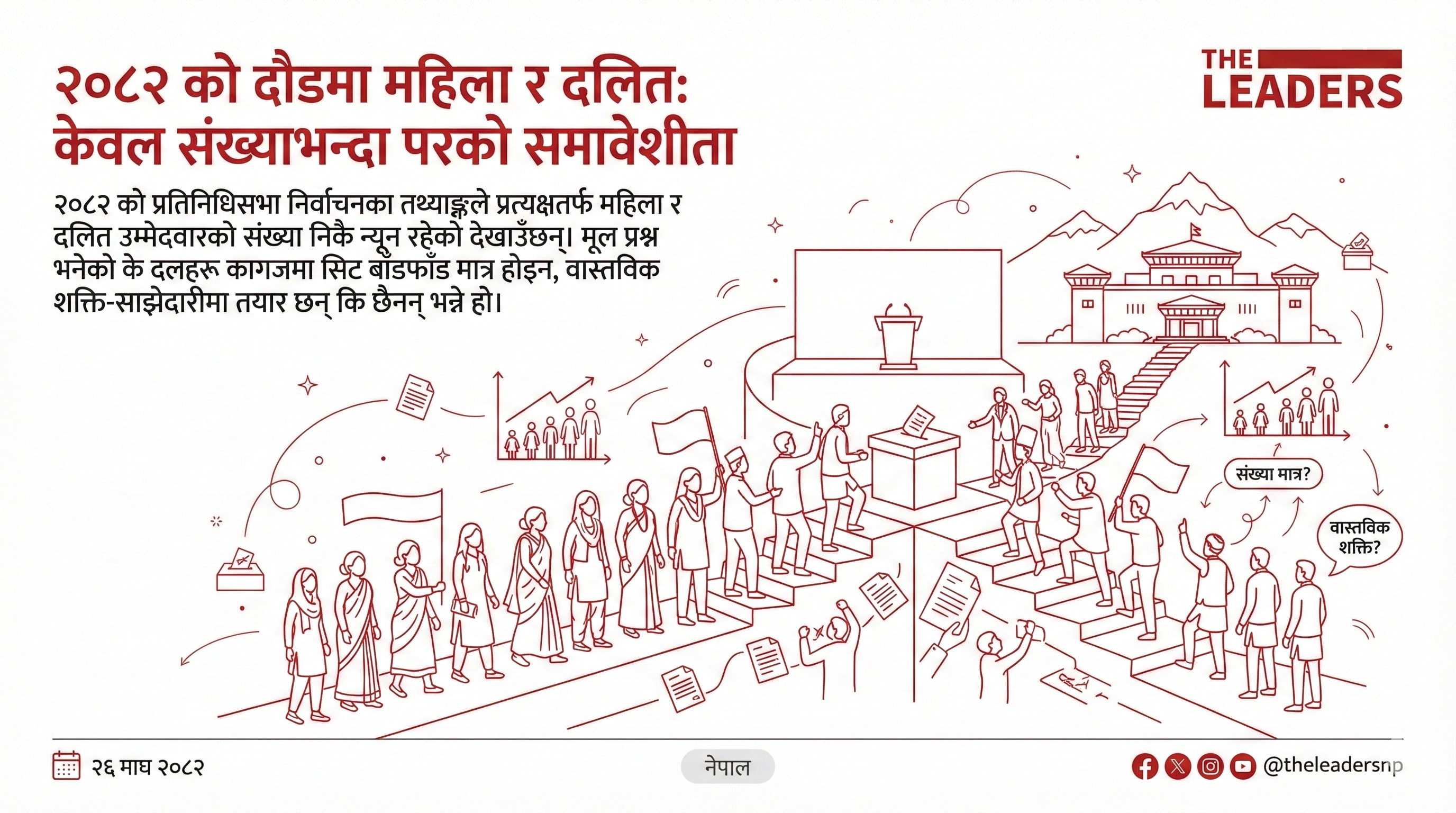
Ahead of the March 5 election, candidate data paint a sobering picture. Nationally, women constitute only about 11.35 percent of candidates contesting the 165 first-past-the-post constituencies. For Dalits, analyses indicate that only a very small number have received direct tickets from major parties. These figures contrast sharply with constitutional promises and political rhetoric about inclusion.
On paper, Nepal’s constitutional framework is relatively progressive. It mandates that each party’s total representation in the House of Representatives must include at least one-third women and reflect the diversity of Dalits, Janajatis, Madhesis, Tharus, Muslims and other groups roughly in line with their population share. To achieve this, 110 of the 275 seats are elected through proportional representation lists specifically designed to correct under-representation.
Why FPTP candidacy still matters
Given this structure, some argue that low direct candidacy is not a serious concern as long as proportional lists are inclusive. This view is short-sighted. First-past-the-post MPs tend to have higher local visibility, greater control over constituency resources and stronger leverage within their parties. When women and Dalits are concentrated in proportional seats, they often lack the same organisational networks and bargaining power.
Field reports suggest that women aspirants frequently face pressure to accept proportional positions instead of contesting direct seats, on the assumption that FPTP races are “too risky” or “too expensive” for them. Dalit leaders, for their part, describe being encouraged to work as local organisers for non-Dalit candidates rather than lead campaigns themselves.
Party structures and candidate selection
These patterns point to deeper issues inside parties. Leadership bodies at federal and provincial levels remain heavily male and dominated by traditionally advantaged groups. Candidate selection committees are often informal, driven by personal loyalty, factional deals and the ability to mobilise money rather than by clear inclusion criteria.
Without transparent rules, potential women and Dalit candidates must convince senior leaders that they are “viable” in winnable constituencies. Even when public pledges are made—such as commitments to one-third women candidacy or stronger Dalit representation—these are rarely backed by binding mechanisms or internal accountability.
The role of proportional lists
Proportional representation remains an important safeguard, and in past elections it has been the primary route for Dalit MPs to enter parliament. Women have also gained significant presence through party lists. For many, this has been a crucial door into national politics.
But proportional lists are not a cure-all. If parties treat them solely as a compliance tool to satisfy legal quotas, they risk reinforcing a two-tier parliament: one dominated by directly elected men from established backgrounds, and another composed of MPs whose influence is constrained by their mode of entry.
A more constructive approach is for parties to use proportional lists to promote emerging leaders—including women and Dalits—into visible roles, support them with resources and gradually transition them into competitive FPTP contests.
What would meaningful inclusion look like?
Meaningful inclusion cannot be reduced to a percentage target. It involves the ability to set agendas, influence budgets and hold executive power. For women and Dalits, this means presence in party decision-making bodies, leadership in thematic committees and fair access to campaign financing.
In the short term, parties can still take corrective measures before March 5. They can prioritise women and Dalit candidates in internal campaigning, allocate them high-profile speaking roles, deploy senior leaders to their constituencies and commit publicly not to sideline them in leadership contests after the election.
In the medium term, legal reforms could be considered to encourage fairer distribution of FPTP tickets, such as financial incentives for parties that exceed inclusion benchmarks or disclosure requirements that force parties to publish candidate breakdowns by gender and caste in user-friendly formats.
The voters’ role
Ultimately, voters also shape parties’ incentives. When citizens scrutinise not just party manifestos but also who is being presented as the face of power in each constituency, they send a signal about the kinds of leadership they value. Supporting capable women and Dalit candidates—even when they are not backed by the largest machines—can gradually reshape party calculations.
The 2026 election will not resolve Nepal’s long-running debates about representation. But it can move the conversation from symbolic inclusion to substantive power-sharing if parties, regulators and voters all push in that direction.