Updating the legal toolkit before a critical vote
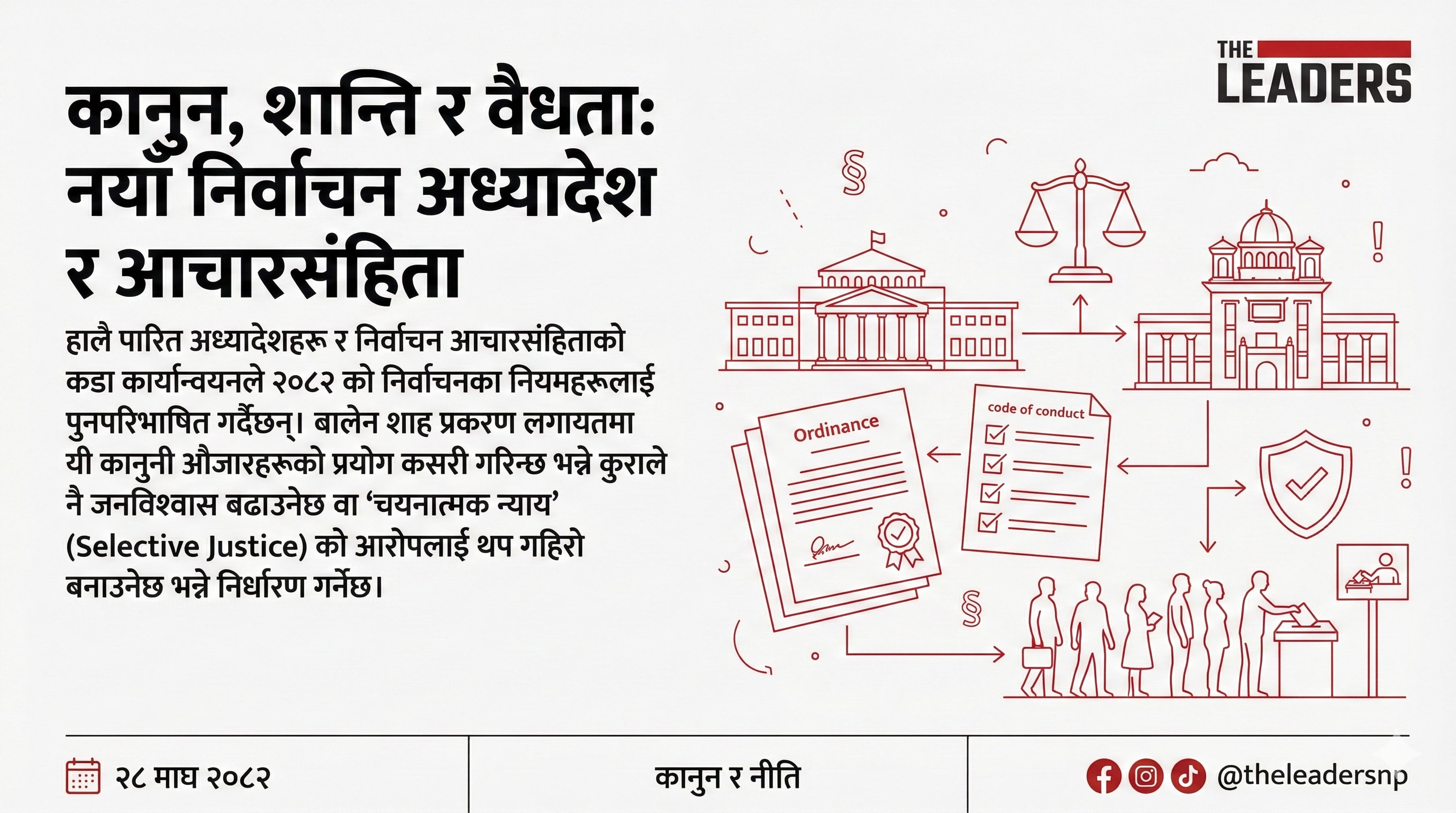
Ahead of the March 5 election, the National Assembly has endorsed three key ordinances: amendments to the voter list law, the House of Representatives election law, and the Nepal Special Service Act. Together, they update the legal toolkit available to the Election Commission and the government to manage a complex national poll. On paper, much of the change looks technical—definitions clarified, timelines fine-tuned, coordination between institutions formalised. But in practice, these provisions matter because they determine who gets on the voter roll, how quickly disputes can be resolved and how far the state can go in deploying its security and intelligence apparatus during the campaign.
The expanding reach of the Code of Conduct
Alongside legal amendments, the Election Commission has signalled a tougher stance on its Code of Conduct. The second clarification notice to Balendra Shah over alleged use of police personnel in his campaign is only the most high-profile example; at least nine individuals have reportedly been questioned over various alleged violations. Firm enforcement can act as a guardrail against abuse of state resources and money power. It reassures opposition parties that incumbents will not enjoy a free hand with government vehicles, staff or security escorts, and it can discipline non-state actors tempted to deploy hate speech or intimidation.
The danger of selective enforcement
Yet the very tools that can protect electoral integrity can also undermine it if used unevenly. If action is perceived as targeting only certain leaders—especially those seen as challengers to the establishment—while overlooking similar behaviour by others, the Code of Conduct risks being dismissed as a political weapon rather than a neutral rulebook. This makes due process crucial. The Commission must apply clear, publicly known criteria: what kinds of evidence trigger a notice, how many days are given for response, when do warnings escalate into fines or disqualification. Publishing anonymised summaries of cases and outcomes could help demonstrate consistency.
Voter lists and the right to be counted
The voter list amendment, meanwhile, goes to the heart of electoral legitimacy: who is recognised as a voter. Past elections have seen anger over missing names, duplicate registrations and confusion around documentation requirements. Each such dispute chips away at citizens’ belief that the system sees them as equal participants. If implemented well, clearer procedures for correcting and cleaning the rolls can reduce litigation, protests and last-minute attempts to delay the vote. But if the process is opaque, it can generate new grievances, especially among marginalised groups who already struggle with documentation and bureaucratic hurdles.
Security laws and civil liberties
Changes to the Special Service Act and related security provisions raise another delicate question: how to ensure safety without sliding into securitisation of politics. Given the memory of heavy-handed responses to protests in recent years, any expansion—or even perceived expansion—of security agencies’ remit will be closely watched. The challenge is to keep polling stations safe and intimidation-free while respecting freedoms of assembly, association and expression that are also guaranteed by the Constitution. Clear chains of command, robust oversight and avenues for citizens to report abuse are essential components of this balance.
Towards rules that build, not erode, trust
Ultimately, laws and codes of conduct are tools, not ends in themselves. Their democratic value lies in how predictably, fairly and transparently they are applied. If the new ordinances and stricter enforcement result in better voter rolls, cleaner campaigns and fewer blatant abuses of power—and if this is seen to be true across party lines—they will strengthen the legitimacy of the 2026 elections. If they are perceived as add-ons selectively activated against inconvenient actors, they will fuel the very mistrust they are meant to dispel. In the weeks before March 5, the Election Commission and other state organs still have time to demonstrate, through their daily decisions, which of these paths Nepal is taking.