Why the election calendar matters
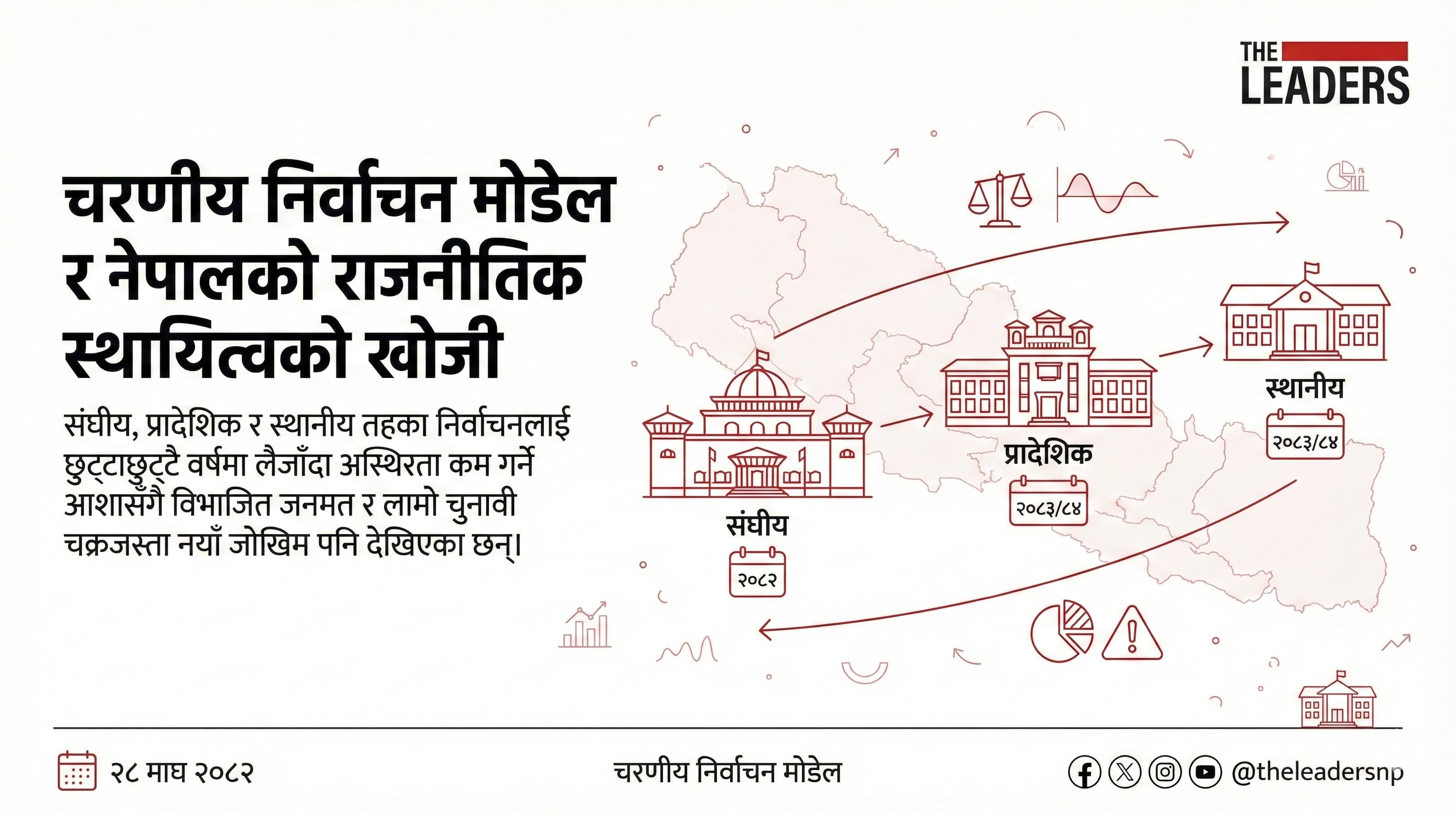
Nepal’s decision to hold the House of Representatives election on March 5, 2026 and to move provincial and local elections to 2027 marks a decisive break from the past decade. In 2017 and 2022, voters faced multiple ballots in quick succession, and in some cases on the same day. This compressed calendar contributed to coalition bargaining, overlapping promises and administrative strain at all three levels of government. By staggering the polls, the Election Commission of Nepal and the interim government hope to create breathing space for the federal system.
Potential gains in stability
A key argument for phased elections is that they can reduce the shock of simultaneous government turnover. When federal, provincial and local executives all change at once, policy implementation often stalls as new officeholders learn their roles and renegotiate priorities. Under the new calendar, a federal government elected in 2026 would continue in office while provincial and local polls are conducted a year later. In theory, this allows the centre to provide continuity and to support subnational transitions, especially in sensitive sectors such as education, health and infrastructure.
Phased polls may also sharpen accountability. Voters can assess the performance of federal leaders separately from that of provincial chief ministers or local mayors. Poor performance at one level does not automatically doom all incumbents, but it does give citizens more frequent opportunities to send targeted signals through the ballot box.
Risks of fragmentation and longer campaign mode
Yet the move is not without trade-offs. One concern is that Nepal could drift into a near-permanent election mode, with parties constantly recalibrating alliances and messages for the next contest. Extended campaign cycles can make it harder to push through difficult but necessary reforms, especially in areas like public finance and civil service restructuring, where short-term costs are high and benefits are delayed.
Another risk is political fragmentation. If voters deliver very different mandates at federal and provincial levels in back-to-back elections, inter-governmental coordination could suffer. For example, a reform-minded federal coalition might find itself blocked by hostile provincial assemblies that were elected on different agendas. Conversely, strong regional forces might gain ground in provinces a year after a relatively centralised federal verdict, complicating budget negotiations and national legislation.
Implications for parties and coalitions
For parties, the phased calendar forces a re-think of strategy. Traditional forces like the Nepali Congress, CPN-UML and CPN (Maoist Centre) have long relied on broad national alliances that cascade down to the provinces and local levels. They must now decide whether to maintain the same coalitions across multiple years or to localise deals based on regional strengths. Newer parties and post–Gen-Z formations could benefit if they manage to build momentum in one tier and carry it into the next.
The sequencing also affects candidate pipelines. Parties that fail to cultivate credible provincial and local leaders while focusing on federal figures may find themselves exposed in 2027. Conversely, those that use the interim year to groom younger or more diverse candidates could translate the energy of 2026 into deeper organisational roots.
What should institutions prioritise?
To ensure that phased elections enhance, rather than erode, stability, three institutional priorities stand out. First, clear rules on coalition formation and government stability at all levels will be essential. Ambiguous provisions can tempt actors to trigger fresh instability between election cycles. Second, predictable fiscal transfers and transparent budgeting can reduce the temptation to politicise resource flows after each vote. Third, robust mechanisms for inter-governmental coordination—through formal councils and informal practice—will be needed to prevent policy drift.
Ultimately, calendar design cannot substitute for political will. Phased elections create an opportunity to reduce systemic shocks, but it is up to parties, the Election Commission, and citizens to use that space to strengthen, rather than weaken, Nepal’s federal democratic project.