
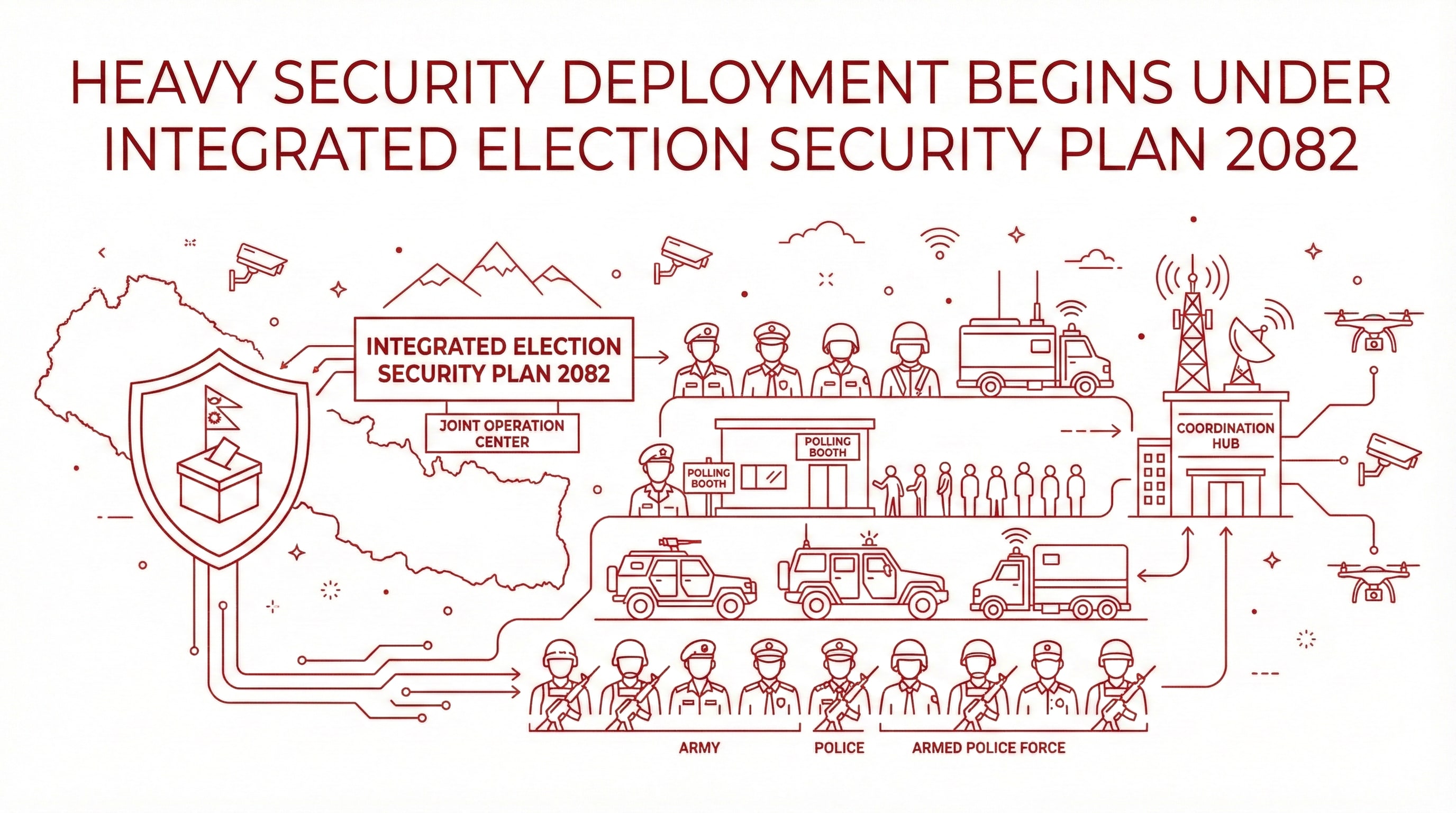
Security preparations for the March 5 House of Representatives election have entered a new phase, with the government and Election Commission implementing the Integrated Election Security Plan 2082.
According to Republica, New Business Age and other outlets citing official briefings, roughly 330,000–340,000 security personnel are being mobilised from the Nepali Army, Nepal Police, Armed Police Force (APF) and specially recruited election police. Around 80,000 army personnel, 77,000 Nepal Police, about 34,000 APF members and more than 130,000 temporary "election police" are being deployed.
Data compiled by the EC and police, reported by Digital Rights Nepal and national dailies, show that 10,967 polling stations and 23,112 polling centres have been designated nationwide. Of these, 3,680 polling stations are classified as highly sensitive, 4,442 as sensitive and 2,845 as normal.
The official plan envisions a layered model: temporary police and Nepal Police secure the inner perimeter of polling centres, the APF forms a second ring, and the army protects outer perimeters and strategic sites like airports, hydropower plants and prisons. Authorities argue that this architecture is necessary given past election violence, the recent Gen‑Z protests and the escape of thousands of prisoners during unrest.
Critics worry that such a visible security footprint, especially in areas where most stations are labelled highly sensitive, could intimidate voters or blur the line between safety and surveillance. For voters, the key questions are whether this deployment will make them feel safer walking to the booth, and whether security forces will maintain strict political neutrality on election day.