
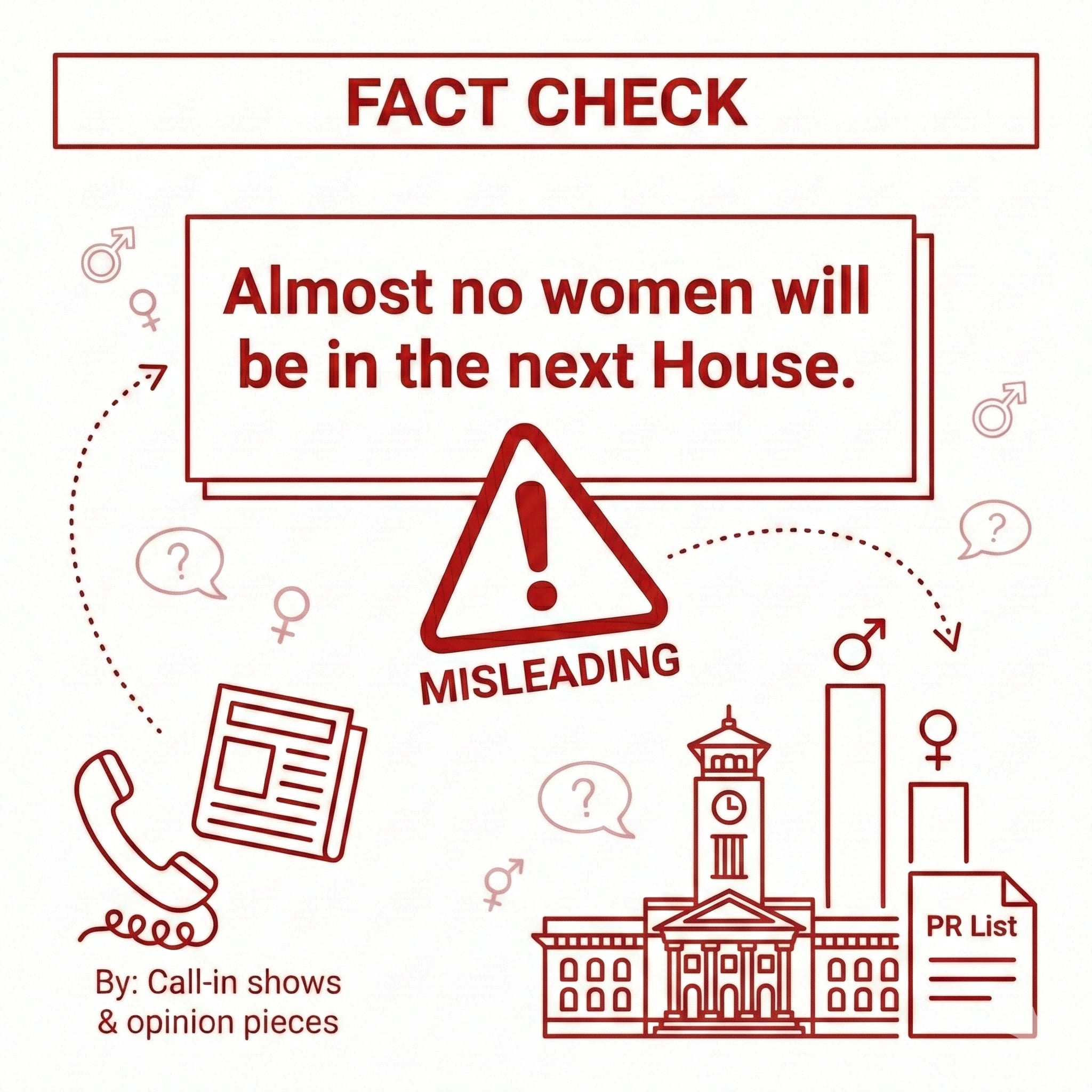
"There will be almost no women in the next House of Representatives because parties did not field women under direct elections."
This dossier summarizes the strongest available evidence and weighs competing claims.
Official Analysis
Reporting from districts such as Sunsari confirms that women remain significantly underrepresented in first-past-the-post (FPTP) races, with women making up around 17 percent of candidates there. This supports the concern that parties have been slow to nominate women in direct contests. However, the Election Commission has also published a proportional representation (PR) closed list in which women outnumber men, with 1,772 women and 1,363 men among 3,135 candidates. The Constitution requires that women hold at least one-third of seats in the federal parliament when FPTP and PR are combined, and parties are legally obligated to meet this overall threshold. The claim accurately reflects a problem in FPTP nominations but is misleading when it suggests that women will be almost absent from the next House; institutional safeguards and the PR lists make that outcome unlikely, even if deeper equality remains far from achieved.
Evidence Index
- Exhibit 1The Rising Nepal
- Exhibit 2Election Commission of Nepal
- Exhibit 3All India Radio News
- Exhibit 4Women’s rights organisations and dialogue reports