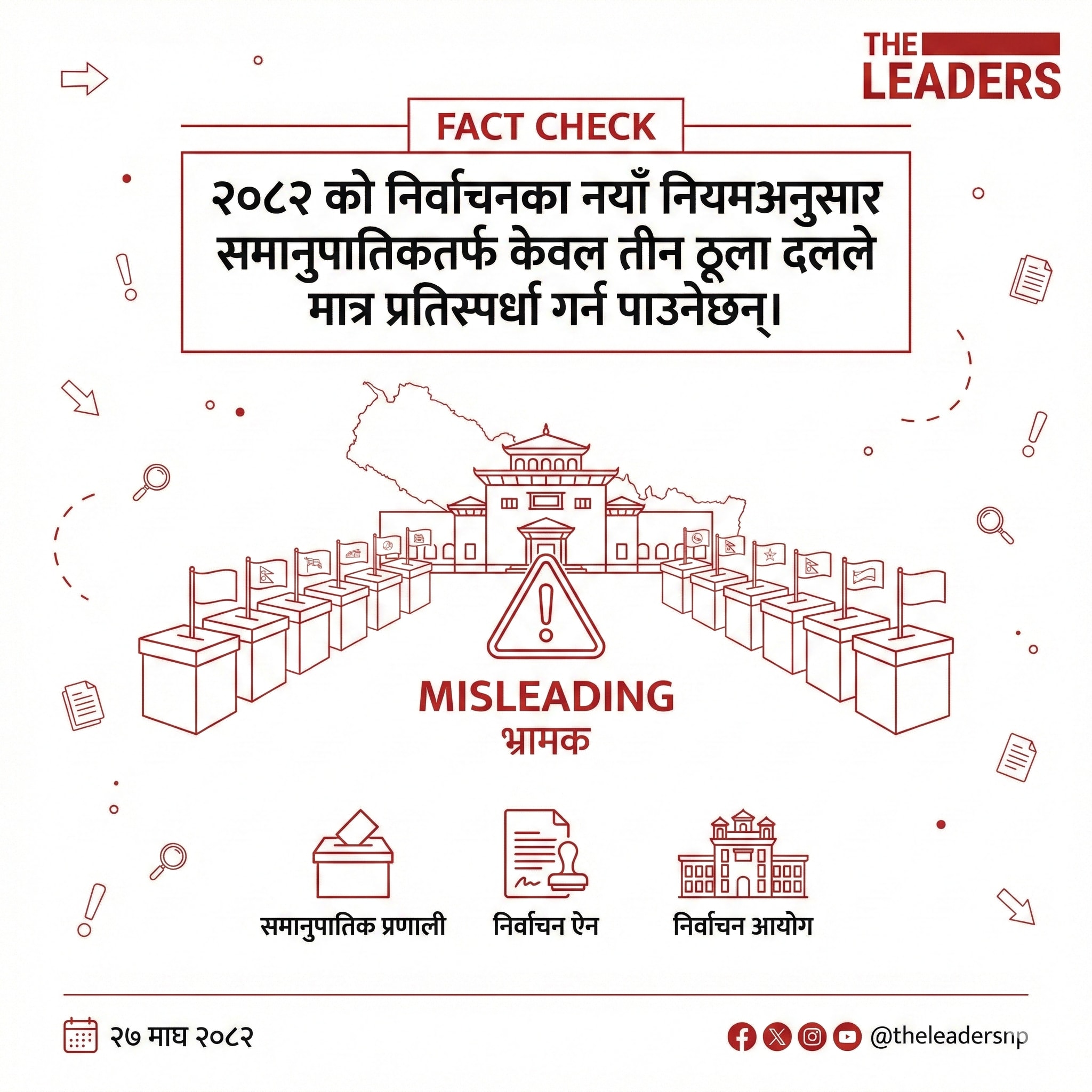
"Under new rules for the 2026 elections, only the three largest parties will be allowed to contest the proportional representation ballot."
This dossier summarizes the strongest available evidence and weighs competing claims.
Official Analysis
Nepal’s federal election system, as outlined in the Constitution and subsequent laws, uses a mixed model with 165 first-past-the-post seats and 110 proportional representation seats. The law retains a national vote threshold (such as 3 percent of valid votes) that a party or alliance must cross to be allocated PR seats, but it does not limit ballot access to only three parties.
Recent ordinances passed by the National Assembly adjust technical aspects of voter list management and House election procedures, but there is no evidence that they have introduced a rule restricting the PR ballot to just the three largest parties by size.
The claim mixes up the idea of a representation threshold (needed for seat allocation) with an imagined cap on how many parties may appear on the ballot. Many registered parties can still contest the PR vote; smaller ones that fail to cross the threshold simply do not receive seats, even though they appear on the ballot and can campaign.
Evidence Index
- Exhibit 1Constitution of Nepal
- Exhibit 2Election Commission of Nepal
- Exhibit 3The Rising Nepal